
Stablecoin Payments for SaaS and Subscription Businesses (2026 Guide)
 Ricky
Ricky

SaaS and subscription businesses can accept stablecoin payments by adding a crypto checkout option to their Shopify or WooCommerce store. Stablecoins like USDT and USDC eliminate two of the biggest recurring revenue killers — failed card payments and fraudulent chargebacks — while opening your subscriber base to customers in regions where credit cards are unreliable or unavailable.
The subscription economy is approaching $300 billion globally in 2026. But the payment infrastructure behind it was built for one-time purchases, not recurring billing. Failed payments cause 20% to 40% of all subscription churn, according to industry benchmarks. International subscribers face higher failure rates due to cross-border card declines, currency conversion errors, and bank-imposed spending limits. Stablecoins offer an alternative payment rail that sidesteps these failure modes entirely.
Why Subscription Businesses Lose Revenue to Payment Failures
Involuntary Churn: The Silent Revenue Killer
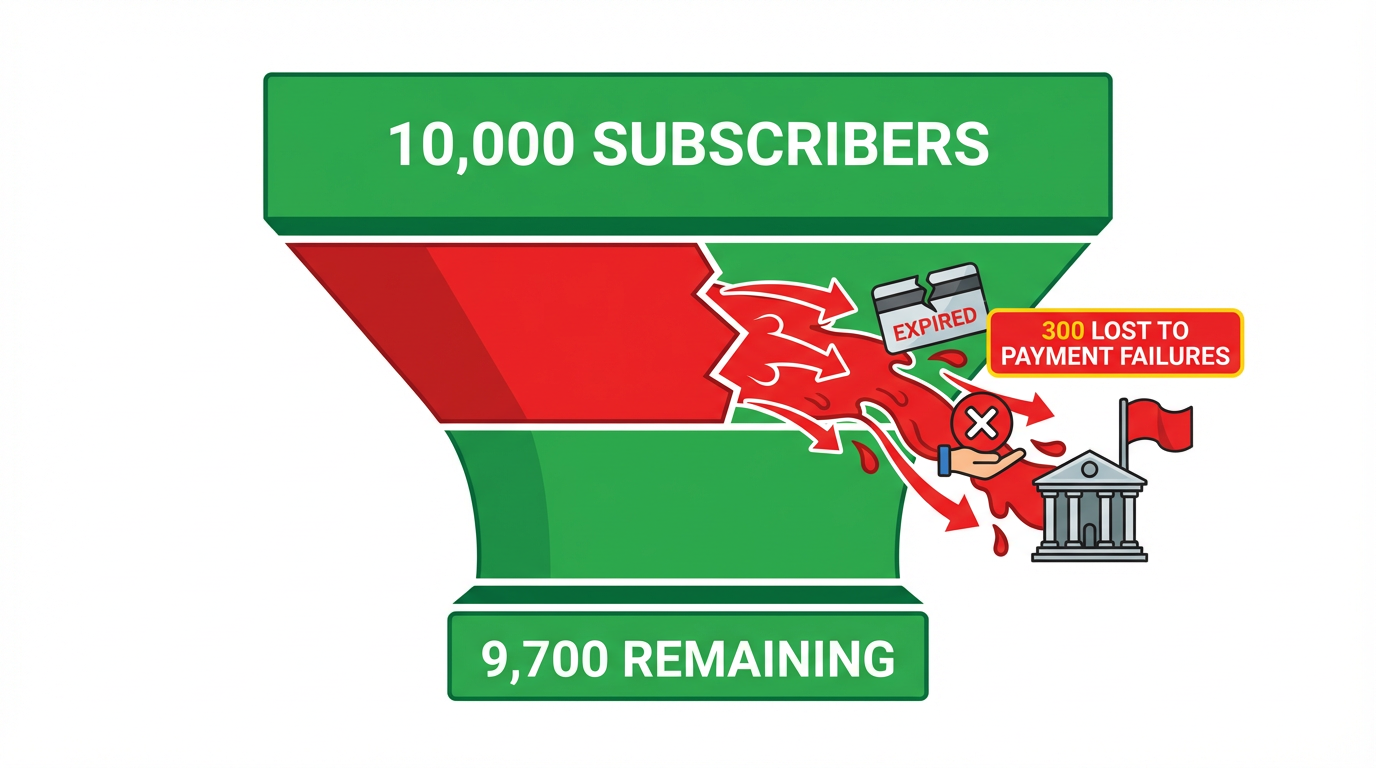
Involuntary churn — subscribers who leave because their payment fails, not because they want to cancel — accounts for 20% to 40% of total churn for the average SaaS business. Card expirations, insufficient funds, bank fraud flags on recurring charges, and cross-border decline codes all contribute. Every failed renewal is a subscriber you have already paid to acquire walking away through no fault of your product.
Dunning systems (automated retry logic) recover some of these failed payments, but recovery rates typically cap at 50% to 70%. The remaining failures become lost revenue. For a SaaS company with 10,000 subscribers at $50 per month, a 3% involuntary churn rate means losing $15,000 monthly — $180,000 per year — to payment infrastructure limitations.
International Subscriber Payment Failures
Cross-border card decline rates are significantly higher than domestic transactions. A subscriber in Brazil paying a U.S. SaaS company faces multiple failure points: their bank may flag the recurring international charge, the card network may apply 3D Secure challenges that time out, or currency conversion may fail if the subscriber’s bank restricts foreign-denominated transactions.
For SaaS companies targeting global markets — developer tools, design platforms, education services, productivity apps — these international payment failures represent a leaky bucket that traditional payment optimization cannot fully patch. You can retry failed charges, send card update reminders, and implement smart dunning, but you cannot fix the underlying issue: credit card infrastructure was not designed for seamless cross-border recurring payments.
Chargeback Fraud on Digital Services
SaaS and digital subscription businesses face higher chargeback rates than physical goods merchants. Proving delivery of a digital service is harder than proving shipment of a physical product. Friendly fraud — where a subscriber uses your service and then disputes the charge — is particularly common for subscriptions, as customers sometimes dispute recurring charges they forgot about or no longer want, bypassing the cancellation process.
Each chargeback costs $15 to $25 in processor fees, plus the lost revenue, plus the operational time spent responding to disputes. High chargeback rates (above 1%) can trigger payment processor penalties or account termination — a catastrophic risk for any subscription business.
How Stablecoins Solve Subscription Payment Problems
No Card Expiration, No Declined Charges
Stablecoin payments do not rely on credit card numbers that expire, banks that flag transactions, or card networks that impose cross-border restrictions. A customer paying with USDC or USDT sends funds from their crypto wallet — a wallet that does not expire, does not get flagged by fraud detection, and does not require bank authorization. The payment either goes through or it does not, with no ambiguous decline codes or partial failures.
For subscription businesses, this means the most common causes of involuntary churn disappear. There are no expired cards to update, no bank-side fraud flags to resolve, and no cross-border decline codes to debug. If the customer has sufficient USDC or USDT in their wallet, the payment succeeds.
Zero Chargebacks
Blockchain transactions are irreversible once confirmed. There is no dispute mechanism, no chargeback process, and no intermediary that can reverse a stablecoin payment after it settles. For SaaS companies losing 0.5% to 2% of revenue to chargebacks and disputes, this is a structural improvement — not a marginal one.
You still handle legitimate refund requests through your own refund policy. The difference is that the decision stays with you. A subscriber who wants a refund contacts your support team, and you process it if warranted. No payment processor overrides your judgment, and no $25 dispute fee is levied regardless of outcome.
Global Access Without Banking Dependencies
A developer in Lagos, a freelancer in Istanbul, or a small agency in Buenos Aires can subscribe to your SaaS product with stablecoins even if their local bank blocks international recurring card charges. Stablecoins are accessible anywhere with an internet connection — no banking relationship required. For SaaS companies pursuing international growth, this unlocks subscriber segments that traditional cross-border payment methods cannot reach.
Lower Processing Costs
Credit card processors charge SaaS companies 2.9% plus $0.30 per transaction on average. For a $29 monthly subscription, that is $1.14 per renewal — 3.9% of revenue. A non-custodial stablecoin gateway like Aurpay charges 0.8% with no per-transaction fixed fee, bringing the cost to $0.23. Over 1,000 subscribers, the monthly savings are $910 — enough to fund another engineer or marketing campaign.
Subscription Payment Flow with Stablecoins
Stablecoin subscription payments work differently from credit card recurring billing. Understanding the flow helps you design the right experience for your subscribers.
Initial Signup
The subscriber selects a plan on your Shopify or WooCommerce store and chooses the crypto payment option at checkout. The gateway generates a payment page showing the exact USDC or USDT amount, your wallet address, and a QR code. The subscriber sends the stablecoin from their wallet. Once confirmed on the blockchain, the subscription activates.
Renewal Payments
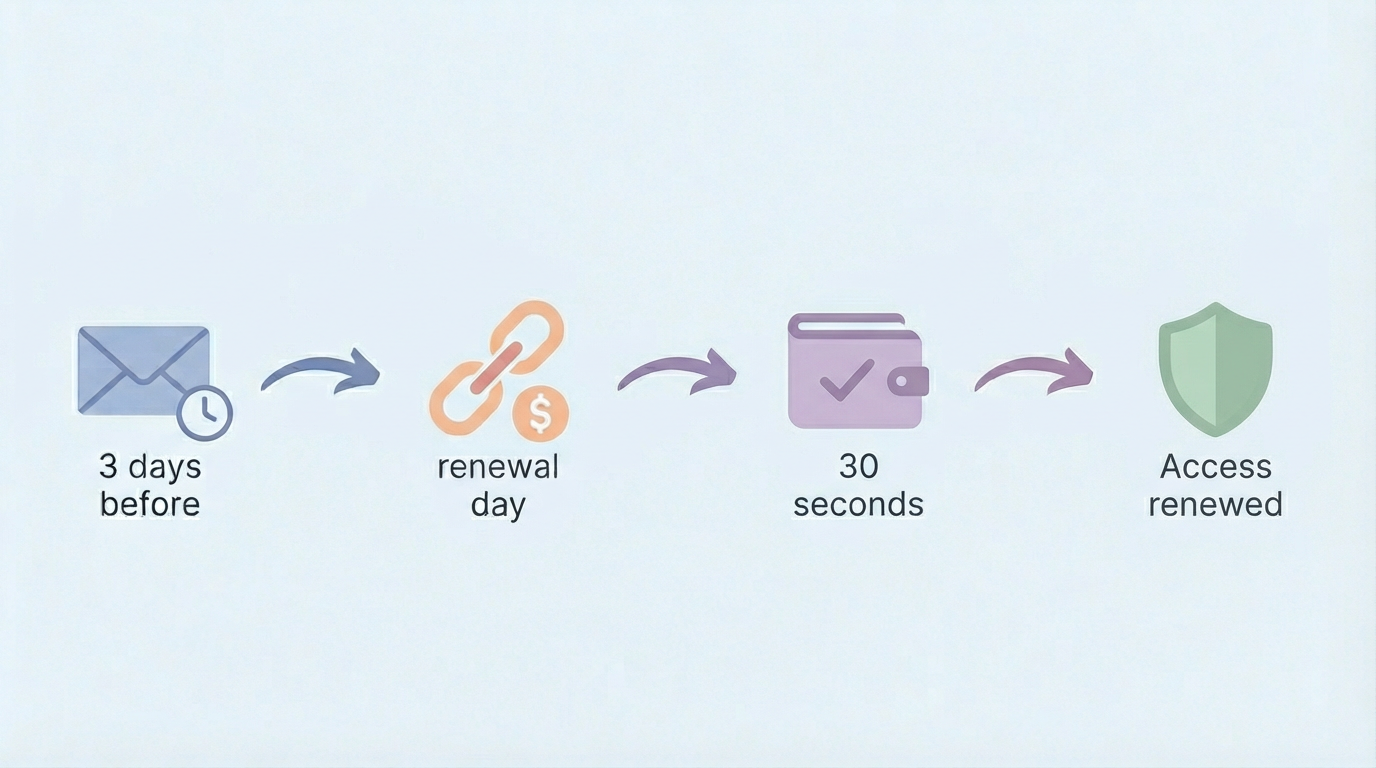
Unlike credit card subscriptions where the merchant initiates the charge, stablecoin renewals require the subscriber to send payment. This is the key architectural difference. Your system sends a renewal invoice (via email or in-app notification) with a payment link. The subscriber clicks, confirms the stablecoin transfer from their wallet, and the subscription renews.
This “pull vs. push” difference means stablecoin subscriptions have a slightly different renewal dynamic than card-based billing. The trade-off is explicit: you lose the convenience of automatic card charging, but you gain zero failed payments (every renewal that is initiated succeeds), zero chargebacks, and access to non-card-holding subscribers globally.
Handling Renewal Reminders
Effective renewal reminders are critical for stablecoin subscriptions. Best practices include:
- Send a reminder email 3 days before renewal with a direct payment link
- Send a follow-up on renewal day if payment has not been received
- Allow a 3 to 7 day grace period before suspending access
- Send a final “your subscription will expire” email at the end of the grace period
Well-designed reminder sequences achieve renewal rates comparable to credit card auto-billing. The key is making the payment process as frictionless as possible — one click to the payment page, scan QR code, confirm in wallet. Total renewal time: under 30 seconds.
Setting Up Stablecoin Subscriptions
On Shopify
Shopify supports subscription products through apps like Shopify Subscriptions, Recharge, or Bold Subscriptions. Install your subscription app of choice, then install the Aurpay Shopify app as a payment method. When a subscriber renews, the Aurpay checkout generates a fresh payment page with the correct amount and wallet address. Enable USDT and USDC on multiple networks (ERC-20, TRC-20, Polygon) to give subscribers the most options.
On WooCommerce
WooCommerce Subscriptions (by Woo) handles the subscription lifecycle — plan creation, renewal scheduling, and subscriber management. Install the Aurpay WooCommerce plugin as a payment gateway. Configure wallet addresses and enable your target stablecoins and networks. WooCommerce Subscriptions will generate renewal orders that Aurpay processes through its standard checkout flow.
Recommended Stablecoin and Network Configuration
For subscription businesses, prioritize networks with the lowest fees — your subscribers pay network fees on every renewal, and high fees create friction that reduces renewal rates.
- Polygon: Less than $0.01 per transaction. Best for subscribers in the Ethereum ecosystem.
- TRC-20: $0.10 to $0.50 per transaction. Best for global subscribers, especially in Asia and emerging markets.
- BSC: Less than $0.10 per transaction. Popular with Binance-ecosystem users.
- ERC-20: $0.50 to $5.00. Enable for compatibility, but subscribers will prefer lower-fee networks for recurring payments.
Always enable at least two low-fee networks. A subscriber who faces a $3 ERC-20 fee on a $15 monthly plan will not renew. The same subscriber paying $0.01 on Polygon will not think twice.
Which SaaS Models Benefit Most
Developer Tools and APIs
Developer-focused SaaS products have the most natural fit for stablecoin payments. Developers are disproportionately crypto-literate, many already hold stablecoins, and they appreciate the transparency of blockchain-based payments. API platforms, hosting services, code tools, and dev infrastructure products should offer stablecoin checkout as a standard payment option.
Digital Products and Online Education
Course creators, template sellers, and digital download platforms face high chargeback rates because proving delivery of digital goods is difficult in card disputes. Stablecoins eliminate this risk entirely. These businesses also tend to have large international audiences — students and creators in emerging markets who face the highest barriers with traditional payment methods. See our guide on crypto payments for digital products for more on this vertical.
Creative and Design Tools
Design platforms, stock media services, and creative tooling often serve a global freelancer audience. Many of these subscribers earn crypto income through Web3 projects, DAOs, or crypto-native companies. Accepting stablecoins lets them pay for business tools with the same currency they earn in, avoiding unnecessary fiat conversion steps.
Privacy-Focused Services
VPNs, encrypted email providers, privacy tools, and security services attract subscribers who value privacy in their payment methods. Stablecoin payments through a non-custodial, no-KYC gateway align with the privacy expectations of this audience. The subscriber does not need to share card numbers, billing addresses, or banking details to complete a payment.
Metrics to Track
Once you add stablecoin payment options, monitor these metrics to measure impact:
Crypto payment adoption rate. What percentage of new subscribers and renewals use stablecoins vs. credit cards? Track this monthly to understand adoption trends. Early adoption rates typically range from 3% to 12%, depending on your audience.
Renewal rate by payment method. Compare stablecoin renewal rates against card-based renewal rates. Factor in that stablecoin renewals require active subscriber action — if your renewal reminder sequence is well-designed, rates should be within 5% to 10% of card auto-renewal rates.
Geographic distribution. Track which countries your stablecoin-paying subscribers come from. If you see significant adoption from markets where you previously had high card decline rates, that confirms stablecoins are unlocking previously inaccessible subscribers.
Chargeback rate comparison. Compare overall chargeback rates before and after adding stablecoin payments. As a portion of transactions shifts to stablecoins (zero chargeback risk), your blended chargeback rate should decrease.
Processing cost savings. Calculate the monthly difference between what you pay for card-processed subscriptions (2.9% + $0.30) vs. stablecoin-processed subscriptions (0.8%). This directly impacts your unit economics.
Start Accepting Stablecoin Subscriptions
Stablecoins do not just save you money on processing fees — they fix structural problems in the subscription payment stack that cost SaaS companies millions in involuntary churn, international payment failures, and chargeback fraud. For businesses with global subscribers, digital products, or developer-focused audiences, stablecoin checkout is not an alternative payment method — it is a better payment infrastructure.
Aurpay’s non-custodial gateway integrates with Shopify and WooCommerce subscription workflows, supporting USDT, USDC, and 10+ cryptocurrencies across multiple networks. Processing fee is 0.8% per transaction with no monthly fees, no KYC requirements, and no custody risk. Set up stablecoin payments and give your subscribers a payment option that actually works — anywhere in the world.