
BitPay vs Non-Custodial Gateways: Why Merchants Are Switching in 2026
 Ricky
Ricky
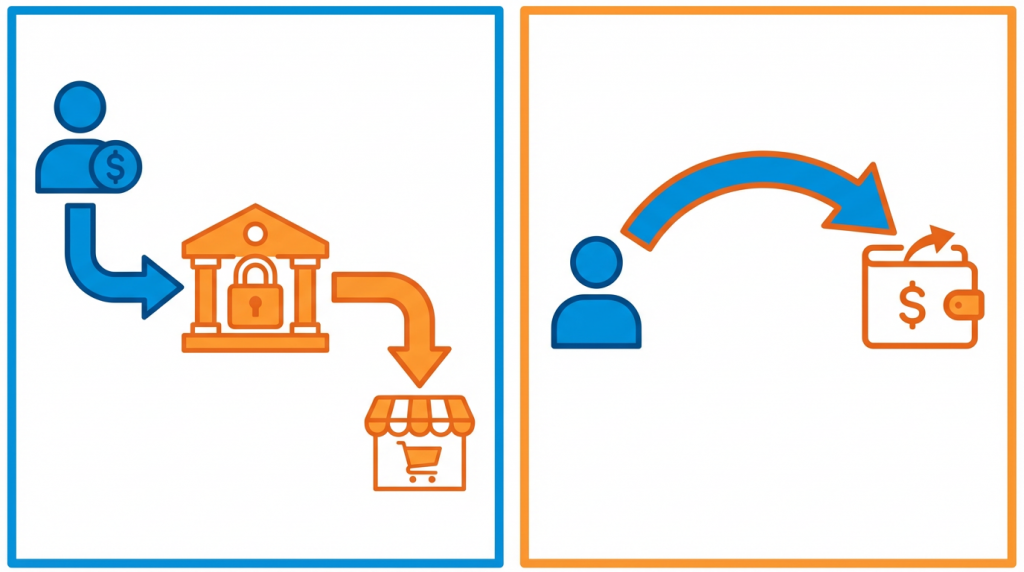
BitPay is the longest-running crypto payment processor, operating since 2011 with fiat settlement, 100+ supported coins, and strong brand recognition among enterprise merchants. But a growing number of businesses are moving to non-custodial gateways in 2026 because they want instant settlement, lower fees, and full control over their funds — without handing custody to a third party.
This guide breaks down the real differences between BitPay and non-custodial alternatives across six dimensions: custody, KYC, fees, merchant control, regulatory risk, and use-case fit. The goal is not to dismiss BitPay. It is to help you decide which model actually matches your business.
How BitPay Works: The Custodial Model
BitPay operates as a custodial payment processor. When a customer pays in crypto, BitPay receives the funds into its own wallets, converts them (if you choose fiat settlement), and deposits the equivalent amount into your bank account. The standard settlement cycle is T+2 business days, though some regions experience longer delays.
This model mirrors traditional payment processing. You never touch the crypto directly. BitPay handles conversion, compliance, and disbursement. For merchants who want a hands-off experience and prefer receiving USD, EUR, or other fiat currencies, this abstraction is the core value proposition.
BitPay supports over 100 cryptocurrencies, integrates with Shopify, WooCommerce, and several other platforms, and offers invoicing tools for B2B payments. The company is licensed as a money transmitter in multiple U.S. states and complies with federal AML/KYC regulations.
How Non-Custodial Gateways Work
A non-custodial gateway never takes possession of your funds. When a customer completes a payment, the crypto moves directly from the buyer’s wallet to your merchant wallet. The gateway facilitates the transaction — generating payment pages, monitoring the blockchain for confirmations, and notifying your e-commerce platform — but at no point does it hold or control your money.
This architecture removes the settlement delay entirely. Once the blockchain confirms the transaction (seconds on Tron or Polygon, minutes on Ethereum), the funds are yours. There is no waiting for a batch payout cycle, no intermediary balance to monitor, and no withdrawal request to submit.
Non-custodial gateways like Aurpay support major stablecoins (USDT, USDC, DAI) and cryptocurrencies (BTC, ETH, BNB, MATIC) across multiple chains including Ethereum, Tron (TRC-20), BSC (BEP-20), Polygon, and Arbitrum. Platform integration is typically limited to Shopify and WooCommerce, which covers the majority of small-to-mid-size e-commerce merchants.
Custody: Who Holds Your Money?
This is the foundational difference. With BitPay, your customer’s payment enters BitPay’s custody from the moment the transaction confirms until settlement completes. During that T+2 window, BitPay controls the funds. If BitPay experiences an outage, a compliance hold, or a regulatory action, your settlement can be delayed or frozen.
With a non-custodial gateway, custody never transfers. The payment moves peer-to-peer from buyer to your wallet address. The gateway is a facilitator, not a financial intermediary. You can verify every incoming payment on-chain, and you can spend or convert the funds immediately after confirmation.
For merchants processing high volumes, the custody question is also a counterparty risk question. If a custodial processor becomes insolvent, your unsettled funds are at risk. The collapses of several crypto custodians in 2022-2023 demonstrated this risk in practice. Non-custodial architecture eliminates it by design.
Settlement Speed Comparison
| Factor | BitPay (Custodial) | Non-Custodial Gateway |
|---|---|---|
| Fund custody | BitPay holds funds until settlement | Funds go directly to merchant wallet |
| Settlement time | T+2 business days (fiat), same day (crypto) | Instant upon blockchain confirmation |
| Counterparty risk | Yes — funds held by third party | None — peer-to-peer transfer |
| Withdrawal process | Automatic batch payout | No withdrawal needed — funds already in your wallet |
KYC and Onboarding: Days vs Minutes
BitPay requires full merchant verification before you can accept your first payment. This includes business registration documents, identity verification for beneficial owners, bank account details for fiat settlement, and in some cases, proof of business activity. The review process takes anywhere from two days to several weeks, depending on your jurisdiction and business type.
Certain business categories face additional scrutiny or outright rejection. BitPay’s acceptable use policy excludes several legal product categories, and merchants in emerging markets often encounter longer verification timelines.
Non-custodial gateways typically require zero KYC. Since the gateway never holds funds and does not perform currency conversion, it does not operate as a money transmitter in most jurisdictions. You connect your wallet address, install the plugin on your Shopify or WooCommerce store, and start accepting payments. Total setup time is roughly 15 minutes.
This difference matters most for merchants who need to launch quickly — seasonal businesses, event-based commerce, or international sellers operating in regions where BitPay’s verification process is slow or unavailable. For a deeper look at the KYC question, see our guide on accepting crypto payments without KYC through non-custodial gateways.
Fees: The Real Cost of Each Model
BitPay’s published processing fee is 1% per transaction. However, the total cost to the merchant can be higher depending on how you settle. If you choose fiat settlement, BitPay applies an exchange rate at the time of conversion. This rate includes a spread that is not separately itemized on your invoice. Merchants who have compared BitPay’s conversion rate against spot prices on major exchanges report effective spreads of 0.5% to 1.5% above mid-market rates.
There are also potential costs around chargebacks (for BitPay’s recently introduced buyer protections), network fees on certain payout methods, and currency conversion fees if you settle in a currency different from the payment denomination.
A non-custodial gateway like Aurpay charges a flat 0.8% processing fee. There is no conversion spread because there is no conversion — you receive exactly what the customer pays, minus the processing fee. Network fees (gas) are paid by the buyer at the time of transaction, which is standard for on-chain payments.
For a detailed breakdown of where custodial fees add up, read our analysis of hidden costs in custodial crypto payment gateways.
Fee Comparison for a $10,000 Monthly Volume
| Cost Component | BitPay | Aurpay (Non-Custodial) |
|---|---|---|
| Processing fee | $100 (1%) | $80 (0.8%) |
| Conversion spread (est.) | $50–$150 | $0 (no conversion) |
| Settlement delay cost* | Variable (T+2 exposure) | $0 (instant settlement) |
| Estimated total cost | $150–$250 | $80 |
*Settlement delay cost represents the opportunity cost and volatility exposure during the T+2 settlement window. In a volatile market, the value of your unsettled funds can shift meaningfully.
Merchant Control and Account Risk
BitPay, like all custodial processors, retains the ability to freeze your account, delay settlements, or terminate your merchant agreement. These actions can happen for compliance reasons, suspicious activity flags, or policy changes. Merchants who have experienced account holds report resolution times ranging from days to months, during which their unsettled funds remain inaccessible.
This is not unique to BitPay — every custodial financial service operates this way. Banks, PayPal, and Stripe all exercise similar controls. But for merchants who adopted crypto payments specifically to reduce dependence on intermediaries, custodial crypto gateways recreate the same power dynamics they were trying to escape.
Non-custodial gateways cannot freeze your funds because they never hold them. Your wallet, your keys, your money. The worst a non-custodial provider can do is terminate your access to their payment page service, at which point you simply switch to another provider. Your existing funds are unaffected because they were never in anyone else’s custody.
For merchants in higher-risk categories — supplements, adult content, CBD, or cross-border e-commerce — this distinction is particularly important. Custodial processors can and do close accounts in these verticals with limited notice. A non-custodial architecture removes that vulnerability entirely.
Regulatory Risk: The OFAC Case Study
In 2021, BitPay reached a settlement with the U.S. Office of Foreign Assets Control (OFAC) for $507,375. OFAC found that BitPay had processed transactions involving buyers in sanctioned jurisdictions — including Crimea, North Korea, Iran, Sudan, and Cuba — between 2013 and 2018. BitPay had collected IP address and geolocation data that could have identified these buyers but failed to screen transactions against OFAC’s Specially Designated Nationals list.
This settlement is instructive for merchants, not because BitPay acted in bad faith, but because it demonstrates a structural risk of the custodial model. When a payment processor holds funds and performs conversion on your behalf, it becomes a regulated financial intermediary. That intermediary’s compliance failures can result in enforcement actions that affect all merchants on the platform — through service disruptions, policy tightening, or reputational risk by association.
Non-custodial gateways occupy a different regulatory position. Because they do not take custody of funds or perform currency conversion, they generally do not qualify as money transmitters or payment service providers under most current regulatory frameworks. This does not mean they are immune to future regulation — the regulatory landscape is evolving rapidly. But today, the compliance surface area is significantly smaller.
For merchants, the practical takeaway is this: using a custodial processor ties your payment operations to that processor’s compliance track record. With a non-custodial model, your payment flow is between you and your customer, with no intermediary whose regulatory issues can interrupt your business.
When BitPay Is the Right Choice
Fair assessment requires acknowledging where BitPay genuinely excels. There are merchant profiles for which BitPay remains the stronger option.
You Need Fiat Settlement
If your business operates entirely in fiat — paying suppliers in USD, reporting revenue in EUR, managing payroll in local currency — then receiving crypto directly creates a conversion burden. You would need to move funds to an exchange, sell, and withdraw to your bank. BitPay handles this end-to-end. For merchants who view crypto as a payment rail rather than an asset they want to hold, this automation is valuable.
You Serve Enterprise Clients
BitPay’s brand recognition matters in B2B contexts. If you are sending invoices to corporate procurement departments, a BitPay-branded payment page carries credibility that newer non-custodial gateways have not yet built. Enterprise buyers are more likely to complete a payment through a processor they recognize.
You Want Maximum Coin Support
BitPay supports over 100 cryptocurrencies and tokens. If your customer base frequently pays in less common altcoins, BitPay’s broader coin support is an advantage. Non-custodial gateways like Aurpay focus on the highest-volume assets — USDT, USDC, DAI, BTC, ETH, BNB, and MATIC — which covers the vast majority of crypto payments but not every long-tail token.
You Need Regulatory Cover
In heavily regulated industries, using a licensed, KYC-compliant payment processor can be a requirement rather than a choice. BitPay’s money transmitter licenses and compliance infrastructure can satisfy auditors and regulators in ways that a non-custodial gateway cannot. If your business needs to demonstrate third-party payment compliance, BitPay provides that paper trail.
Side-by-Side Comparison
| Feature | BitPay | Aurpay (Non-Custodial) |
|---|---|---|
| Operating since | 2011 | 2022 |
| Custody model | Custodial — holds funds until settlement | Non-custodial — funds go direct to your wallet |
| Processing fee | 1% | 0.8% |
| Settlement | T+2 business days (fiat) / same day (crypto) | Instant on blockchain confirmation |
| KYC required | Yes — full merchant verification | No |
| Setup time | Days to weeks | ~15 minutes |
| Fiat settlement | Yes (USD, EUR, GBP, and more) | No — you receive crypto directly |
| Supported coins | 100+ | USDT, USDC, DAI, BTC, ETH, BNB, MATIC |
| Supported chains | Multiple (varies by coin) | Ethereum, Tron, BSC, Polygon, Arbitrum |
| E-commerce platforms | Shopify, WooCommerce, and others | Shopify, WooCommerce |
| Account freeze risk | Yes — custodial control over funds | No — your wallet, your funds |
| Regulatory status | Licensed money transmitter | Non-custodial (no MSB license required) |
For a broader comparison that includes additional gateways beyond BitPay, see our full 6-gateway crypto payment comparison for 2026.
How to Switch from BitPay to a Non-Custodial Gateway
If you have decided that non-custodial is the right model for your business, the migration is straightforward. Here is a step-by-step process that minimizes disruption to your store.
Step 1: Set Up Your Wallet
Choose a non-custodial wallet that supports the chains and tokens you want to accept. For most e-commerce merchants, a wallet supporting USDT and USDC on Tron (TRC-20) or BSC (BEP-20) covers the highest volume with the lowest network fees. Hardware wallets like Ledger or Trezor add an extra security layer for larger volumes.
Step 2: Install the Gateway Plugin
If you run a Shopify store, install the Aurpay app from the Shopify App Store. For WooCommerce, install the Aurpay plugin from the WordPress plugin directory. Connect your wallet address during setup. The entire process takes about 15 minutes.
Step 3: Run Both Gateways in Parallel
Do not deactivate BitPay immediately. Run both payment options for two to four weeks. This lets you compare conversion rates, monitor customer preferences, and verify that the non-custodial flow works smoothly with your order management system. Most e-commerce platforms support multiple payment gateways simultaneously.
Step 4: Monitor and Compare
Track three metrics during the parallel period: payment completion rate (do customers finish checkout at the same rate?), effective cost per transaction (including any conversion spreads on BitPay), and settlement speed. Most merchants find that stablecoin payments through non-custodial gateways have higher completion rates than volatile-asset payments through BitPay, because the buyer knows exactly how much they are sending.
Step 5: Deactivate BitPay
Once you are satisfied with the non-custodial performance, disable BitPay in your store settings. Make sure all pending BitPay settlements have completed and any remaining balance has been paid out. Keep your BitPay account active (but not connected to your store) for 90 days in case of any delayed settlement issues.
Choosing the Right Model for Your Business
The custodial vs non-custodial decision is not about which gateway is objectively better. It is about which model fits your operational reality. If you need fiat payouts, enterprise brand recognition, and broad altcoin coverage, BitPay delivers a proven, compliant solution. If you want lower fees, instant settlement, zero KYC, and full control over your funds, a non-custodial gateway like Aurpay is the stronger fit.
The merchant migration trend in 2026 is real, driven by three converging factors: stablecoin adoption making fiat conversion less necessary, rising awareness of custodial counterparty risk, and fee sensitivity in a competitive e-commerce market. But the right choice depends on your specific business needs, not on industry trends.
Ready to see how non-custodial payments work in practice? Try Aurpay’s non-custodial gateway — connect your wallet, install the plugin, and start accepting crypto payments on your Shopify or WooCommerce store in under 15 minutes. No KYC, no fund custody, and a flat 0.8% fee.