
Hermes Agent vs OpenClaw: Crypto User Comparison 2026
 Aurpaytech
OpenClaw crossed 345,000 GitHub stars before Hermes Agent shipped its first public release. Six months later, Hermes has crossed 164,000 stars, a meaningful share of active OpenClaw developers have migrated, and the two agents are pulling in opposite directions on every dimension that matters for crypto use: memory depth, skill security, exchange integration, and how much you trust an autonomous agent with real funds.
This comparison focuses on what traders, DeFi operators, and crypto merchants actually care about, not abstract benchmarks. Both are open-source, both run locally, and both connect to the financial infrastructure that already runs on crypto rails. But they make fundamentally different bets on where AI agent risk comes from and how to contain it. That difference matters when the agent has access to a wallet.
The short version: two different theories of the agent
OpenClaw’s model is Gateway-First: a multi-channel hub that routes natural-language commands to 50-plus connected platforms, amplified by a marketplace of tens of thousands of community skills. It reached critical mass fast (late 2025 launch, six-digit stars in under 60 days) because it gave developers immediate, plug-and-play access to an ecosystem that already existed. The tradeoff is that the ecosystem also brought malicious participants and a security debt that is still being paid down.
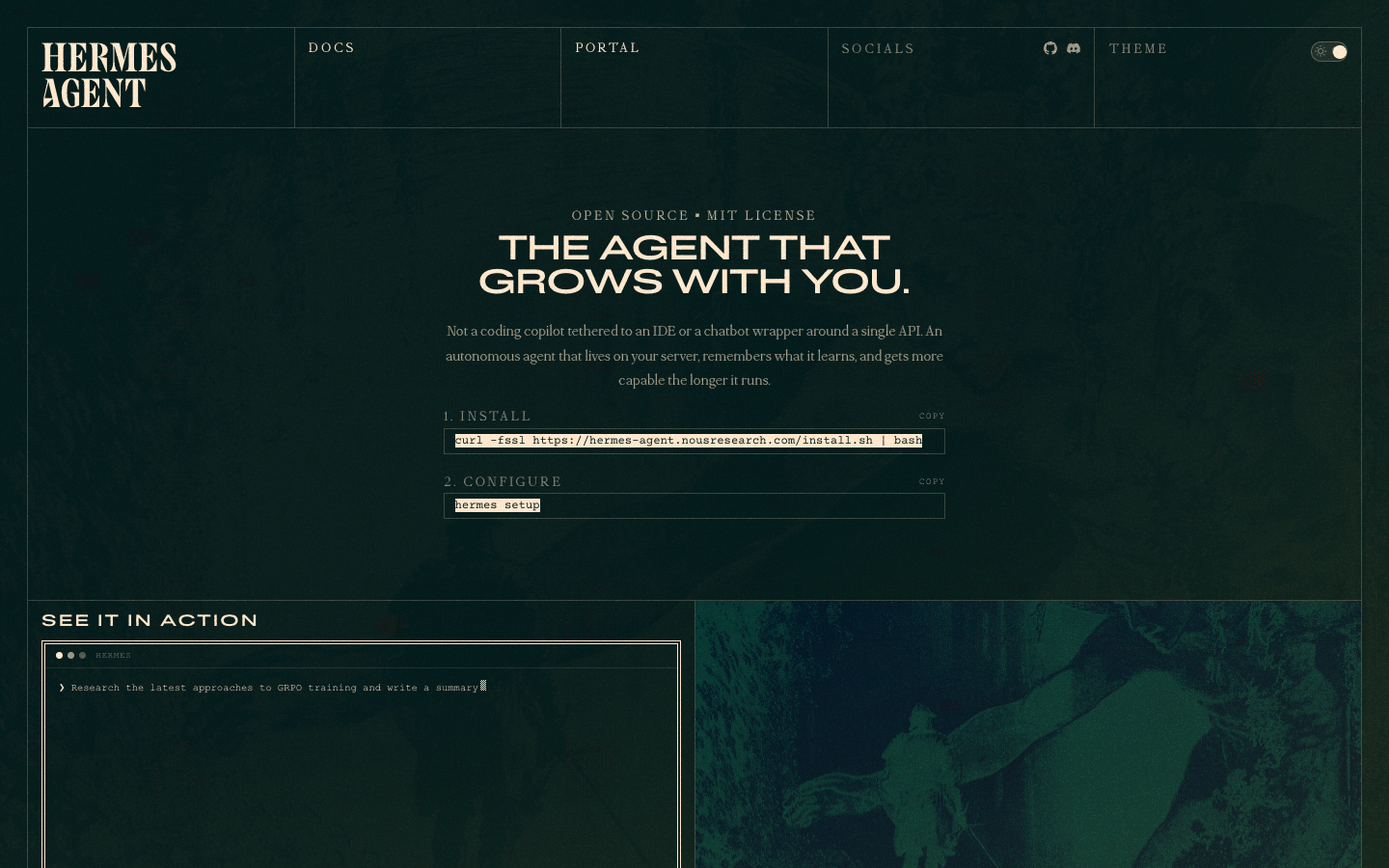
Hermes Agent’s model is Integrated Runtime with Closed-Loop Learning: a single agent that writes and improves its own skills from experience, maintains a layered memory across sessions, and prioritizes depth over breadth. Nous Research (launched February 25, 2026) built it from a different premise: the bottleneck in autonomous agent work is not the number of skills available but the agent’s ability to learn, remember, and recover from failure. The tradeoff is a steeper setup curve and a smaller integration footprint out of the box.
For a full technical introduction to Hermes, see our Hermes Agent guide for crypto users. For OpenClaw’s broader ecosystem, see our complete OpenClaw trading skills guide.
Side-by-side at a glance
| Dimension | OpenClaw | Hermes Agent |
|---|---|---|
| GitHub stars (May 2026) | 345,000+ | 164,000+ |
| Launch date | Late 2025 | February 25, 2026 |
| Architecture model | Gateway-First, multi-channel | Integrated Runtime + closed-loop learning |
| Skill ecosystem | Tens of thousands on ClawHub | ~40 bundled tools + self-generated skills |
| Memory per turn | ~1,800 tokens | 8,000+ tokens (trajectory front-loading) |
| Memory recall latency | ~19,593 ms (Regolo benchmark) | ~113 ms (Regolo benchmark) |
| CVEs disclosed | 138+ including 7 critical (CVSS above 9.0) | 3, all medium severity |
| Independent security audit | No comparable single audit | Community audit #7826 (v0.8.0): 4 Critical / 9 High / 9 Medium; no malware found, default ALLOW-ALL posture flagged |
| Malicious skills | 1,184 in ClawHavoc (confirmed); ~12% malware rate at peak | No third-party skill marketplace |
| Initial setup time | Under 30 minutes (Docker Compose) | 2–4 hours (full local configuration) |
| OpenClaw migration tool | — | hermes claw migrate; many users report switching |
| Crypto integrations | ClawHub crypto skills, BankrBot, Polyclaw | Coinbase MCP, Polymarket, IBKR, ClawStreet |
| License | Open-source | MIT |
| Exposed public instances | 135,000+ via Shodan | Not documented |
Memory architecture: why it matters for trading strategy iteration
The most consequential difference for anyone running crypto trading workflows is memory depth. An AI agent that forgets your strategy parameters between sessions forces you to re-specify context every run. An agent that remembers (and learns from what worked and what did not) compounds value over time in exactly the way a good quant analyst would.
OpenClaw loads approximately 1,800 tokens of context per turn. That is sufficient for conversational tasks and simple automations but constrains complex multi-step strategies. The agent handles memory through SOUL.md with selective recall, so it can retrieve specific past interactions, but the per-turn context window is relatively lean. For short-horizon tasks — execute a trade, check a balance, send an alert — this is rarely a bottleneck.
Hermes front-loads over 8,000 tokens per turn when it has relevant trajectory data. The memory system is three-layered: MEMORY.md for persistent agent state, USER.md for your profile and preferences, and a SQLite FTS5 full-text search index over all past sessions. Regolo’s published benchmark measured OpenClaw’s memory recall at 19,593 ms median latency versus Hermes at 113 ms, a 173x difference in how fast the agent retrieves relevant context from prior sessions.
For trading workflows, the practical difference is strategy iteration speed. If you are running a multi-signal mean reversion strategy and the agent needs to recall how it handled a specific market condition three sessions ago, Hermes surfaces that context in under 200 ms. OpenClaw may need several seconds, during which the relevant market window can close. For asynchronous research tasks, that gap is irrelevant. For anything latency-sensitive, it is real.
Hermes also writes its own skills in Markdown and persists them to memory during a session. After 10–20 similar tasks, the refined skill executes 2–3x faster than the first run. This closed-loop improvement is not available in OpenClaw, where skills are either installed from ClawHub or written manually by users.
Skill ecosystems: scale versus safety
OpenClaw’s ClawHub marketplace expanded from a few thousand skills in early 2026 to tens of thousands within months. No other AI agent framework comes close on breadth. For crypto specifically, ClawHub hosts BankrBot (multi-chain trading across Base, Ethereum, Polygon, Solana, and Unichain), Polyclaw (Polymarket CLOB trading), whale-tracking tools, DeFi monitoring skills, and hundreds of exchange integrations. If there is a crypto workflow you want to automate, there is probably a ClawHub skill for it.
The cost of that breadth is security. The ClawHavoc campaign deposited 1,184 confirmed malicious packages on ClawHub. At its peak, approximately 12 percent of ClawHub submissions contained malware, primarily Atomic macOS Stealer (AMOS), a payload targeting crypto wallet seed phrases, browser credentials, and Keychain data across 150 wallet types. The malware category “financial trading skills” was one of the most heavily targeted vectors, with fake Polymarket bots and ByBit integrations used as lures.
Hermes takes the opposite approach: roughly 40 bundled tools, no third-party marketplace, and the skill creation model shifts to the agent itself. When Hermes encounters a task it does not have a skill for, it writes one in Markdown, validates it, and stores it for future use. The upside is zero supply-chain attack surface for externally published skills. The downside is that you cannot browse a catalog of pre-built crypto integrations — you either use the built-in tools (Coinbase MCP, Polymarket, IBKR, ClawStreet) or you describe what you need and let the agent build it.
For traders who want to go live quickly on familiar platforms, OpenClaw wins on availability. For traders who need to know exactly what is running, Hermes wins on auditability. The question is whether you would rather audit a third-party skill repository once or trust that the agent’s self-generated skills stay within expected scope.
Crypto integrations: what actually connects
OpenClaw’s crypto integration story is largely community-driven. ClawHub’s finance category covers most major CEX APIs, several DEX integrations, on-chain analytics tools, and prediction market connectors. The quality ranges from production-grade (BankrBot is actively maintained, audited by the community, and processes real volume) to unmaintained one-person projects that have not seen a commit since January. Vetting individual skills requires checking GitHub commit history, star counts, and issue activity before trusting any skill with wallet access.
Hermes ships with four crypto-adjacent integrations as first-party tools: Coinbase MCP for exchange interaction, Polymarket for prediction market positioning, Interactive Brokers (IBKR) for cross-asset portfolio management, and ClawStreet for quantitative strategy execution. These are tested against the official APIs and maintained by the Hermes team rather than third-party contributors. The coverage is narrower, but integration quality is more consistent.
One integration detail worth noting: OpenClaw’s Polyclaw skill requires a rotating residential proxy to bypass Cloudflare on Polymarket’s CLOB endpoints, a dependency that introduces its own cost and reliability risk. Hermes’s native Polymarket integration is designed to handle authentication through official Polymarket API credentials rather than proxied scraping, though the specific implementation details warrant testing against your own setup before deploying capital.
For DeFi power users who want deep integrations across many protocols simultaneously, OpenClaw’s ecosystem breadth is hard to replace. For traders running fewer but more reliable integrations with lower maintenance overhead, Hermes’s first-party tools make more sense. The 30 percent of active developers who migrated from OpenClaw cited “maintenance fatigue” as the primary reason: keeping ClawHub skills compatible with API changes becomes significant at scale.
Security and financial risk: the audit gap
This section matters more than any benchmark if you are connecting either agent to a wallet with real funds. Read it before skimming the rest.
OpenClaw has accumulated 138+ disclosed CVEs, including 7 rated critical (CVSS above 9.0) and 49 rated high severity. The most widely reported — CVE-2026-25253 (CVSS 8.8), the cross-site WebSocket hijacking flaw nicknamed ClawBleed — let an attacker hijack a gateway session and reach remote code execution, while two separate critical issues (CVE-2026-22172 and CVE-2026-32922) carry CVSS 9.9 scores. Over 135,000 OpenClaw instances are publicly exposed on Shodan, 63 percent with gateway authentication disabled. That exposure means a compromised or malicious skill has a potential attack path to not just your OpenClaw instance but any API credentials stored in ~/.openclaw/, which the agent stores in plaintext by default.
Hermes has disclosed three CVEs, all rated medium severity: CVE-2026-7396 (WeCom path traversal), CVE-2026-7112 (API authentication), and CVE-2026-7397 (symlink following). But the more revealing document is an independent community audit of Hermes v0.8.0 (GitHub issue #7826), which reviewed 812 Python files and flagged 4 Critical and 9 High findings, including unrestricted shell execution, full filesystem read access, and a container approval bypass. The auditor found no malware, backdoors, or data exfiltration, but concluded that Hermes ships with a default ALLOW-ALL security posture that creates real risk for users who do not harden it. The takeaway is not that Hermes has fewer CVEs. Its risk concentrates in default configuration rather than in a third-party marketplace. The architecture does include real controls: container isolation across multiple backends, credential stripping from MCP child processes, SSRF protection, and dangerous-command approval workflows with a hardline blocklist. The attack surface is smaller partly because the agent does not expose a community-facing plugin distribution system. More context sits in Contract Auditing with Claude Code.
For a detailed breakdown of how to harden either agent for crypto use, see our Hermes Agent security guide and the OpenClaw security risk guide.
The practical security difference for crypto traders comes down to threat model. With OpenClaw, the primary risk is the skill ecosystem: a malicious skill with crypto wallet access can drain funds, and the ClawHavoc incidents showed that marketplace screening is insufficient to stop sophisticated supply-chain attacks at scale. With Hermes, the primary risk is self-generated skill scope: an agent that writes its own tools could, in principle, write a skill that exceeds intended permissions, though the seven-layer security architecture and container isolation significantly limit blast radius.
Neither agent should have access to a wallet you cannot afford to lose entirely. That is not a framework-specific recommendation — it is the base assumption for any autonomous agent operating on blockchain infrastructure.
Automated trading and strategy iteration
For automated crypto trading, memory depth and error recovery are more operationally relevant than the number of available skills. A trading agent that remembers how it handled a volatile session last week (what parameters it adjusted, which signals it weighted more heavily) produces better outcomes over time than an agent that starts fresh every run.
Hermes’s closed-loop learning model gives it a structural advantage for strategy iteration. Reported gains of around 40% faster task completion with self-generated skills reflect real efficiency when the agent is repeating similar analytical tasks: scanning market structure, applying the same technical filters, generating the same report format. After initial calibration, the agent’s skill refinement compounds. OpenClaw executes individual tasks well but does not retain this kind of procedural improvement across sessions.
OpenClaw’s fast median response latency matters for interactive use, but automated trading workflows are typically not latency-bound at the agent orchestration layer. The bottleneck is order execution latency on the exchange, not the time it takes the agent to formulate an instruction. Regolo’s memory benchmark (19,593 ms vs 113 ms recall latency) is more operationally significant for strategy workflows that need to reference prior session data.
One scenario where OpenClaw maintains a genuine edge is multi-platform portfolio management across many simultaneous integrations. ClawHub’s breadth means you can run concurrent monitoring across 20-plus protocols simultaneously, routing alerts to Telegram, Discord, and custom webhooks through a single gateway. Hermes’s smaller integration footprint makes this kind of broad simultaneous monitoring harder to achieve without custom skill development.
For the one trading strategy that has been documented with specific parameters (not profit figures): a Hermes-based implementation used 14 trades over 48 hours, combining multiple signal types with mean reversion. The value of that documentation is the workflow reproducibility, not the specific outcome — past sessions are queryable, so the strategy can be refined based on actual execution history rather than backtests alone.
Setup and maintenance reality
The 30-minute OpenClaw setup versus 2–4 hour Hermes setup reflects a real difference in initial friction. The maintenance story inverts after the first week.
OpenClaw’s Docker Compose installation is genuinely fast. The agent runs out of the box, ClawHub gives you immediate access to a large skill library, and the documentation is extensive. The maintenance cost shows up later: ClawHub skills have variable update cadences, API compatibility breaks regularly, and documented heartbeat delivery reliability issues (a frequently cited user complaint) introduce risks for any automation that depends on consistent execution.
Hermes requires more upfront configuration: connecting messaging platforms, setting up container isolation, configuring MCP integrations for your specific crypto tools, and calibrating the memory system for your workflow. The payoff is a lower ongoing maintenance burden, since the agent adapts its skills to API changes rather than depending on a third-party skill publisher to push updates. The hermes claw migrate tool can port OpenClaw configurations into Hermes, which is why migration friction is lower than a ground-up setup.
If you run a lot of concurrent crypto integrations or depend on community skill development for specialized protocols, the ClawHub ecosystem makes OpenClaw the more practical choice despite the maintenance overhead. If you run fewer but more critical integrations and want the agent to improve over time rather than staying at baseline, Hermes’s setup investment pays back.
Community and development trajectory
OpenClaw’s development pace is reflected in its release history: well over 100 releases as of May 2026, a fast-moving codebase with frequent patches. The tradeoff is stability, since each update carries risk of breaking existing skill integrations or configuration. The community is large and active, which means faster responses to new CVEs and more available community help, but also more noise in evaluating which skills are trustworthy.
Hermes released v0.14.0 on May 16, 2026, and its PR velocity has accelerated every release cycle. The v0.12 cycle alone merged more than 550 pull requests from over 200 contributors, a sharp broadening from the project’s initial core team. The project is still younger and smaller than OpenClaw, but the development trajectory is steep.
Both frameworks have active crypto-specific subcommunities. Hermes attracts more developers building with the first-party financial integrations (Coinbase MCP, IBKR), while OpenClaw’s crypto community is more concentrated around ClawHub skill development. Your choice of framework affects which community you can draw on when something breaks at 2 AM during a volatile trading session.
Who should use which framework
OpenClaw is the better choice if you:
- Need fast access to a wide range of pre-built crypto integrations and are willing to audit skills before installation
- Run multi-platform monitoring across many simultaneous protocols and need the broadest possible coverage
- Prioritize quick setup and a large support community over security depth
- Are prototyping crypto workflows and want to iterate fast before committing to a production-grade setup
- Rely on specific community skills (BankrBot, Polyclaw) that have no Hermes equivalent yet
Hermes is the better choice if you:
- Run fewer but more critical integrations and need audit confidence in what the agent is executing
- Have complex multi-session strategy workflows that benefit from deep memory and learning across sessions
- Are moving significant capital through the agent and need the lower CVE exposure and better container isolation
- Are comfortable with a 2–4 hour initial setup in exchange for lower ongoing maintenance overhead
- Want the agent to improve its own execution quality over time rather than staying at baseline
If you are a merchant accepting crypto payments:
Neither framework is the right tool for payment infrastructure. They are trading and automation agents, not payment gateways. Both are increasingly used alongside payment systems, though: OpenClaw for automated reconciliation workflows, Hermes for customer payment monitoring and treasury management automation.
The critical distinction is custody. OpenClaw skills that interact with wallets depend on the skill author’s security practices. Hermes’s container isolation provides a stronger custody boundary for anything the agent touches. In either case, your payment-side funds should never be in the same wallet the agent has access to. The agent is speculative infrastructure; your payment receipts are business revenue. Keeping them architecturally separated (agent wallet on one side, merchant wallet on the other) is the one design decision that no security layer within the agent itself can substitute for.
This is where a non-custodial payment gateway becomes operationally relevant regardless of which agent framework you choose. When a customer pays, the funds should settle directly to your own wallet, not to an intermediary that requires a separate withdrawal step, and not to a hot wallet the agent can touch. Aurpay processes payments non-custodially at a flat 0.8% fee, with funds settling directly to the merchant’s wallet at confirmation. There is no custody risk, no intermediary holding period, and no dependency on the agent’s operational status.
The custody question that both frameworks leave unanswered
Both OpenClaw and Hermes are agent orchestration frameworks. Neither is a custody solution. The question of where your funds actually live, and who can move them, sits one layer below the agent, at the wallet and payment infrastructure level.
For traders, the answer is: use a dedicated bot wallet with the minimum necessary balance, separate from any long-term holdings or business revenue. For merchants running crypto payment operations alongside AI trading workflows, the separation is more important still: your business revenue should settle to a wallet the agent cannot reach, governed by keys only you control.
That separation (autonomous agent on one side, non-custodial payment settlement on the other) is the architecture that survives a compromised skill, a bad trade, or an agent update that breaks a strategy. Both frameworks are capable tools for building sophisticated crypto workflows. Neither of them should be the answer to the question of who holds your keys.
Update: one custody answer now covers both frameworks
MetaMask launched Agent Wallet on August 6, 2026, and it lists both OpenClaw and Hermes among the agent frameworks it connects to, alongside Claude Code, Codex, OpenCode and Cursor. The design keeps private keys with the user and gives the agent a bounded allowance: a spending ceiling you set, an allowlist of protocols it may touch, and simulation of each transaction before it is signed.
This does not resolve the question raised in the previous section, since an agent acting within its allowance can still lose money. It caps how much. For anyone running either framework against a live balance, it is the closest thing to a standard answer the ecosystem has produced, and we covered how it works in our guide to MetaMask Agent Wallet.
Your payment infrastructure should not depend on your agent’s uptime
Whatever agent framework you build on, your customer payment flow needs to be independent of it. Aurpay is a non-custodial crypto payment gateway: BTC, ETH, USDT, USDC, and Lightning Network, settling directly to your wallet at 0.8% per transaction with no contracts or banking details required. Your payments run whether the agent is online or not. See how Aurpay works.