
2026 Macro Reset: Tariffs, Safe Havens, and Crypto’s New Era
 Ricky
Ricky

If the first three weeks of this year are a prelude to the rest, 2026 will be recorded in financial history as the year the “Great Divergence” became undeniable. We are witnessing a violent decoupling—not just of economies, but of correlations that have held for a decade. The sterile, algorithmic comfort of the “60/40” portfolio has been incinerated by the twin flames of resource nationalism and transactional diplomacy.
The world sits at a precarious juncture. On one side, we have the accelerating “financialization of everything”—a digital renaissance driven by the institutional adoption of cryptocurrencies, the passing of the GENIUS Act, and the integration of Artificial Intelligence into the very plumbing of Wall Street. On the other, we see a chaotic return to 19th-century realpolitik: The United States seizing foreign heads of state, threatening trade wars over Arctic territories, and weaponizing the dollar in ways that force emerging markets to flee into the hard, immutable embrace of gold.
This report, exhaustive in its detail and scope, dissects these colliding forces.
We analyze the trajectory of Bitcoin as it wrestles with its identity in an institutional era, the relentless ascent of Gold amidst the fracturing of NATO alliances, and the macroeconomic undercurrents defined by the International Monetary Fund’s (IMF) latest forecasts. This is not merely a summary of events; it is a strategic roadmap for navigating a year where the rules of engagement—both military and monetary—are being rewritten in real-time.
Part I: The Geopolitical Matrix – A World Unmoored
To understand the asset price movements of January 2026—why Bitcoin dipped below $91,000 while Gold shattered ceilings to reach $4,849—one must first dissect the geopolitical shocks that have redefined risk premiums. The “peace dividend” of the post-Cold War era is not just gone; it has been replaced by a “conflict tax” that is levying heavy tolls on global supply chains and alliance structures.
1.1 The Greenland Crisis: Transactional Diplomacy Gone Rogue
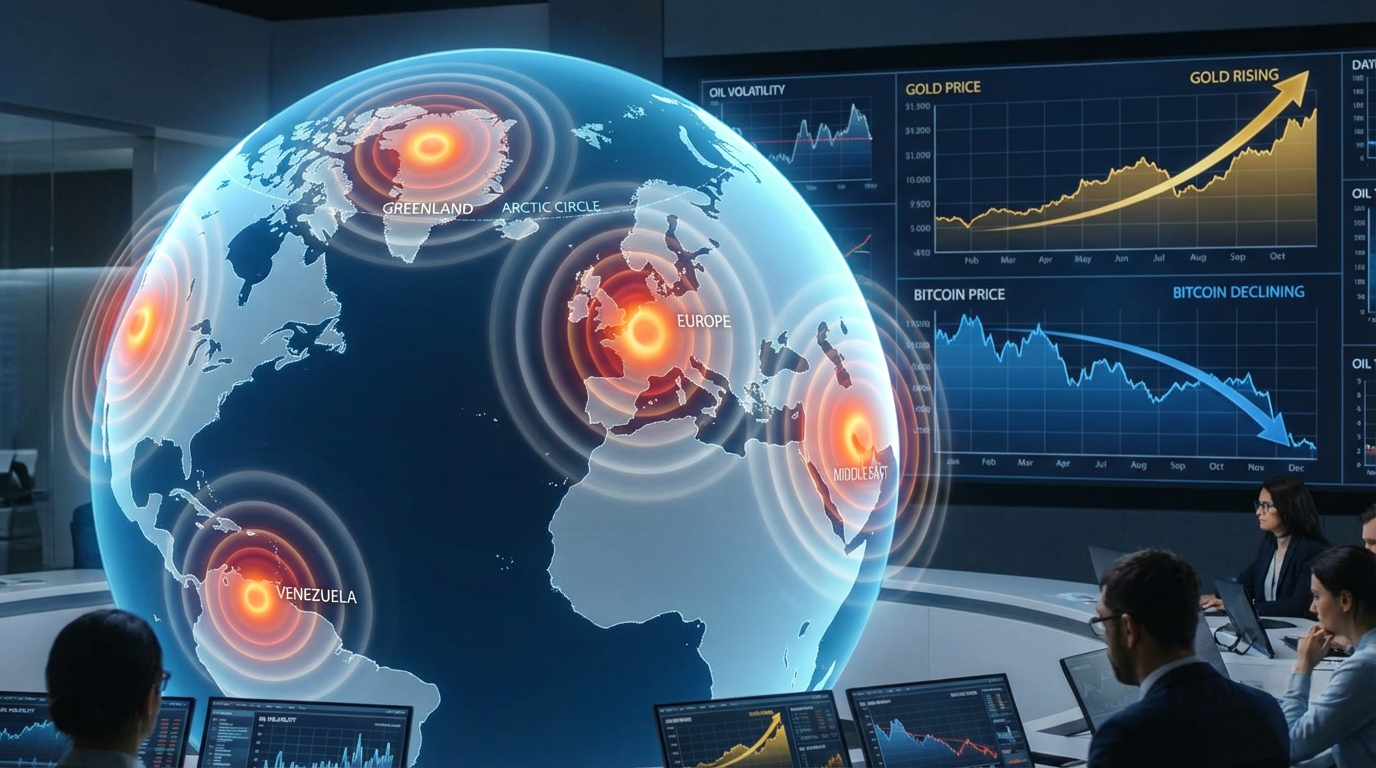
In a move that stunned Brussels and delighted contrarian macro strategists, the Trump administration’s renewed interest in purchasing Greenland has escalated from a real estate developer’s daydream to a full-blown diplomatic crisis. The administration’s logic is rooted in “Resource Realism”—Greenland is not merely an island; it is a fortress of rare earth minerals essential for the AI and semiconductor supply chains that define 21st-century hegemony.
However, the execution has triggered what the International Monetary Fund (IMF) describes as a “spiral of escalation”.The threat of 10% tariffs on eight European nations—including staunch allies like Denmark, the UK, France, and Germany—has shattered the illusion of NATO solidarity.The European Union’s threat to deploy its “anti-coercion instrument” (the so-called trade bazooka) signals that the transatlantic trade alliance is fraying at the seams.
The “TACO” Trade and Market Psychology
Interestingly, a segment of the market has begun to price in what is colloquially known as the “TACO” trade—standing for “Trump Always Chickens Out”.Historical analysis of the 2025 tariff threats suggests a pattern: the administration announces a maximalist economic threat (e.g., 50% tariffs on the EU), the market sells off violently, and the administration subsequently walks back the threat to a more moderate position after extracting concessions.
However, relying on the TACO effect in 2026 is fraught with danger. The University of Massachusetts Economics Professor Arin Dube notes that the TACO dynamic undermines itself over time; if markets stop reacting to threats, the administration may be forced to escalate until the bluff becomes policy.This game of chicken has created a high-volatility environment where “selling the rumor and buying the news” has become a perilous strategy.
Market Implication:
This is the “Sell America” trade in action. When the US weaponizes tariffs against allies for territorial expansion, the risk premium on US assets rises. The immediate casualty was not the dollar—which remains buoyed by high rates—but the trust in US institutional stability. This specifically hurt risk-on assets like Bitcoin (viewed increasingly as a tech proxy) while catapulting Gold (the anti-political asset) to record highs.The divergence is stark: on the day the Greenland tariffs were announced, Gold rallied +3.7% while Bitcoin shed 3.8%.
1.2 The Capture of Maduro: The Doctrine of Direct Intervention
In early January 2026, the geopolitical chessboard was upended by the US military’s seizure of Venezuelan President Nicolás Maduro in an operation dubbed “Operation Absolute Resolve”.While operationally a display of overwhelming US power projection, the financial ramifications are complex and far-reaching.
Operation Absolute Resolve details:
The operation involved the physical capture of a sitting head of state, who was subsequently transported to the Metropolitan Detention Center in Brooklyn to face charges of narcoterrorism.This event, unprecedented in modern diplomatic history, signaled to the Global South that the US is willing to bypass international norms of sovereign immunity to enforce its domestic laws extraterritorially.
The Shadow Fleet and Energy Markets
The seizure of Maduro was accompanied by a crackdown on the “Shadow Fleet”—tankers used by Venezuela and Russia to evade sanctions. By seizing over half a dozen vessels in Venezuelan waters, the US is not just enforcing sanctions; it is asserting kinetic control over global energy flows.This has disrupted the “oil-for-debt” arrangements Venezuela had with China, where crude cargoes were used to service billions in outstanding loans.
Strategic Insight:
The market initially misread this as a bullish signal for Bitcoin (as a censorship-resistant asset), causing a brief “knee-jerk” rally above $93,000 immediately following the capture.However, the reality was a “flight to safety” that ultimately bypassed digital assets. The capture reinforced the power of the US state apparatus. Institutional investors, fearing further escalation or “tit-for-tat” cyber warfare from state actors like Russia or Iran, liquidated liquid assets (crypto) to cover margins or move into Treasuries and Gold.
1.3 The Gaza “Board of Peace” and Global Governance
Amidst the chaos in the Western Hemisphere, a new framework for Middle Eastern stability has emerged: the “Board of Peace.” Formally announced in January 2026, this international body, chaired by US President Donald Trump, is tasked with overseeing the post-war transition in Gaza.
India’s Strategic Role:
Notably, India has been invited to hold a permanent seat on this board, contingent on a $1 billion contribution.This inclusion underscores India’s rising status as a geopolitical broker, distinct from the Western alliance structure but crucial for legitimacy in the Global South. For investors, this signals that Indian diplomatic equity is rising, potentially reducing the country risk premium for Indian assets despite the global turbulence.
Part II: The Global Economic Engine – A Fragile Resilience
The macroeconomic backdrop for 2026 is defined by a tug-of-war between the deflationary forces of technology and the inflationary forces of trade fragmentation. The IMF’s January 2026 World Economic Outlook Update describes the global economy as “steady amid divergent forces,” a polite euphemism for a fractured recovery.
2.1 Global Growth Forecasts: The AI Offset
The IMF projects global growth at 3.3% for 2026, unchanged from 2025. However, the composition of this growth has shifted dramatically.
| Region / Country | 2025 Growth (Est) | 2026 Growth (Proj) | 2027 Growth (Proj) | Key Drivers & Risks |
|---|---|---|---|---|
| Global | 3.3% | 3.3% | 3.2% | AI investment offsetting trade tensions |
| United States | 2.1% | 2.4% | – | Surging technology capex; strong consumption |
| China | 4.2% | 4.5% | – | Easing trade tensions (temporarily); stimulus |
| India | 7.3% | 6.7% | 6.5% | Domestic demand; base effects; fiscal consolidation |
| Euro Area | 0.9% | 1.3% | – | Lagging productivity; vulnerability to trade wars |
| United Kingdom | 1.4% | 1.3% | 1.5% | Services sector resilience; tariff risks |
The AI Productivity Thesis:
The IMF explicitly attributes the resilience of the US economy—upgraded to 2.4% growth—to “heavy investments in artificial intelligence”.This is the “AI Offset”: the theory that massive capital expenditure in data centers, GPUs, and automation software is creating enough economic activity to counteract the drag from higher tariffs and geopolitical instability. The US economy is benefiting from companies investing in technology at the strongest pace since 2001.
Deep Insight – The Vulnerability of the Offset:
This reliance on AI investment creates a binary risk profile for the global economy. If the productivity gains from AI are realized, the “soft landing” continues. However, the IMF warns that if “expectations about how much AI can boost productivity are scaled back,” investment could drop precipitously, triggering a correction in equity markets heavily influenced by big tech.The global economy is essentially leveraged long on the success of Large Language Models.
2.2 Inflation and Monetary Policy: The “Sticky” Last Mile
Global headline inflation is expected to decline from 4.1% in 2025 to 3.8% in 2026.However, the path is uneven.
- United States: Inflation is expected to return to target slower in the US than in other advanced economies.This “stickiness” is driven by the very same AI investment boom that is powering growth—high demand for energy, skilled labor, and specialized hardware is inflationary.
- India: Retail inflation is expected to rise to 5.2% in FY26 before moderating, driven by food prices and demand pressures.
- Central Bank Action: Markets are pricing in rate cuts (approx. 50bps by the Fed in 2026), but the strong growth and sticky inflation data might force the Fed to keep rates “higher for longer” than the dovish consensus expects. This creates a persistent headwind for non-yielding assets, although Gold seems to have decoupled from this traditional correlation.
Part III: The Golden Renaissance – Real Assets in a Fractured World
If 2025 was the year Gold woke up, 2026 is the year it decoupled from traditional financial logic. The yellow metal is not just rallying; it is repricing the geopolitical risk of the entire monetary system.
3.1 The Breakdown of Correlations
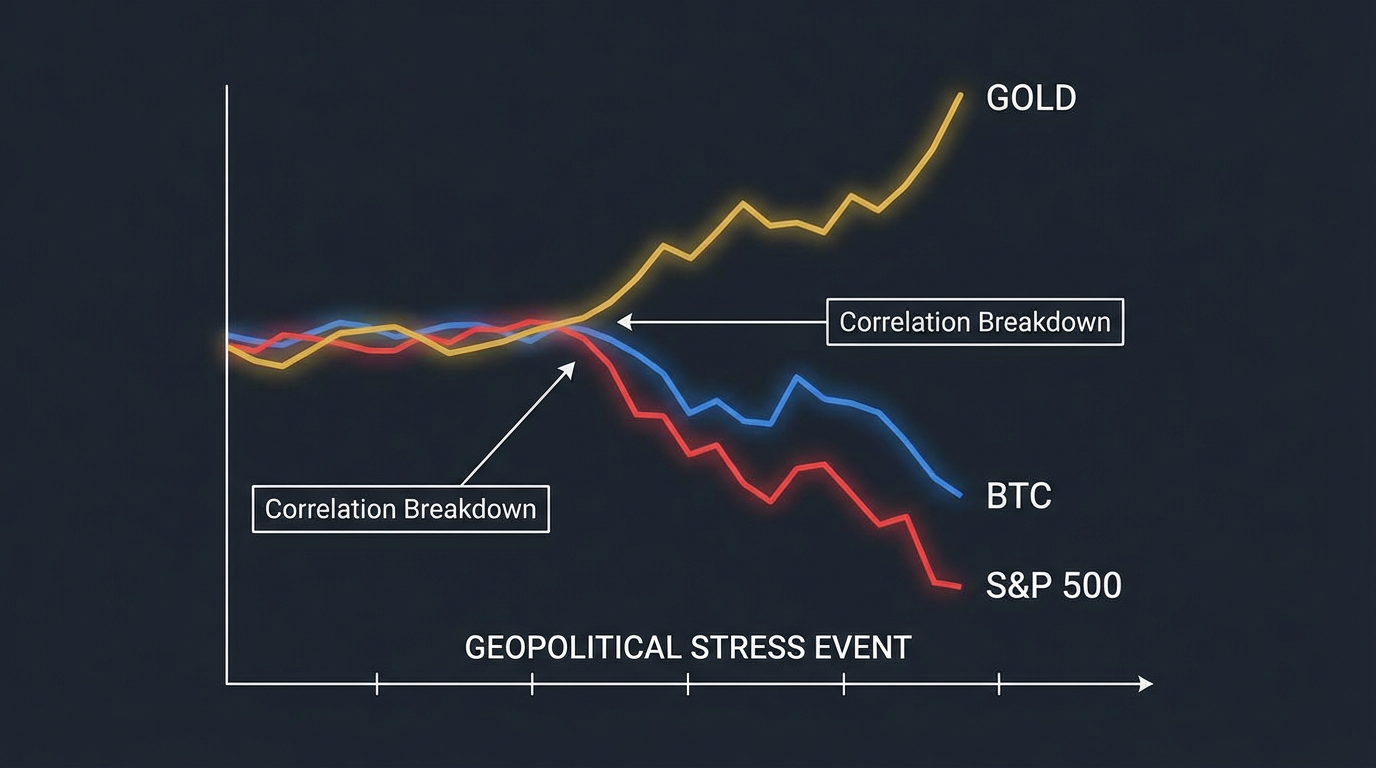
Historically, Gold moves inversely to real interest rates and the US dollar. In 2026, this relationship has fractured. Gold has surged alongside a relatively strong dollar and high rates.
- The Catalyst: The Greenland crisis and the Maduro seizure acted as accelerants. On January 20, 2026, amidst tariff threats, Gold rallied to a record $4,849 per ounce.
- The Divergence: On the same day Gold rallied, Bitcoin fell -3.8% and the S&P 500 dropped over 2%.This empirically dismantles the “Bitcoin is Digital Gold” narrative in times of acute geopolitical stress. Investors sought sovereign safety, not digital safety.
3.2 Price Targets and Structural Shifts
Wall Street has been forced to chase the price action, revising forecasts upward to match the new reality.
| Institution | 2026 Year-End Target | Rationale |
|---|---|---|
| Goldman Sachs | $5,400 | Structural shift in central bank demand; ETF inflows |
| Trading Economics | $5,312 | Global macro models; inflation persistence |
| Technical Analysis | $7,000 (Long Term) | Fibonacci extension targets post-consolidation |
| IG Markets | $4,700 – $5,000 | Declining real yields; debt concerns |
The “De-Westernization” of Reserves:
The driver of this rally is the sovereign entity, not the retail speculator. Emerging market central banks—specifically China, India, Turkey, and Russia—are aggressively accumulating gold.This is a defensive move against the weaponization of the US dollar. The logic is clear: if the US can seize Venezuelan assets or threaten tariffs on NATO allies, holding US Treasuries becomes a national security risk for non-aligned (or even aligned) nations. Goldman Sachs estimates central bank purchases will average 60 tonnes per month throughout 2026.
3.3 Silver: The Industrial Catch-Up
Silver enters 2026 with strong structural support, driven by a fifth consecutive year of supply deficit.
- The Ratio: The Gold/Silver ratio remains elevated, suggesting silver is undervalued relative to gold. An adjustment toward the historical average of 60 would imply significant upside for silver.
- Forecasts: Major banks forecast silver in the $56-$65 range for 2026, with technical models suggesting a breakout toward $72 or even $88 if the “fear trade” spills over into the broader metals complex.
Part IV: The Institutionalization of Crypto – The 2026 Paradigm
Despite the short-term volatility caused by geopolitics, the structural trend for cryptocurrency in 2026 is undeniable: Deep Institutionalization. The asset class is migrating from the fringes of finance to the regulated core, driven by legislative clarity and the entry of global banking giants.
4.1 The GENIUS Act: The Dollarization of the Internet
The most significant development in the crypto ecosystem is the passing of the GENIUS Act (Guaranteeing Essential National Infrastructure in US-Stablecoins) in July 2025.This legislation has provided the regulatory guardrails necessary for institutional capital to enter the stablecoin market.
Key Provisions and Implications:
- Permitted Issuers: The Act makes it unlawful for any person other than a “permitted payment stablecoin issuer” to issue a stablecoin in the US.Permitted issuers are limited to:Subsidiaries of Insured Depository Institutions (IDIs) (i.e., banks).Federal Qualified Nonbank Payment Stablecoin Issuers approved by the OCC.State Qualified Issuers approved by state regulators (limited to <$10 billion market cap before federal oversight kicks in).
- Reserve Requirements: Stablecoins must be backed 1:1 by high-quality liquid assets like US coins, currency, and Treasury bills.
- Extraterritorial Reach: The Act applies to any offer or sale of stablecoins to persons in the US, effectively forcing offshore issuers to comply or exit the market.
The Strategic Consequence:
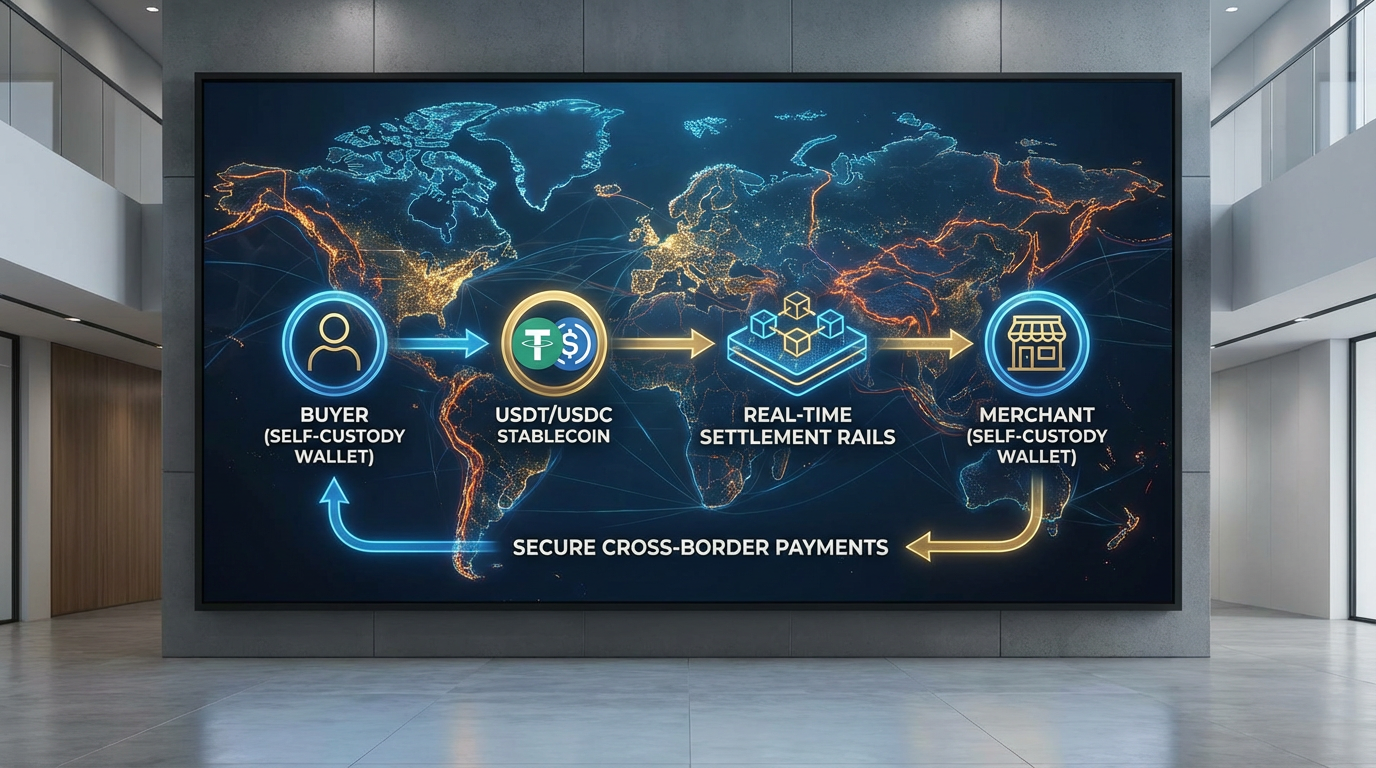
The GENIUS Act effectively grants the US banking system a monopoly on the issuance of digital dollars. It creates a firewall between “regulated crypto” (bank-issued stablecoins) and “shadow crypto” (algorithmic or unbacked tokens). For institutions, this removes the counterparty risk associated with offshore entities, paving the way for stablecoins to become the “internet’s dollar” for B2B payments and settlement.
4.2 The Banking Pivot: From Skepticism to Service
The “reputational risk” that once held banks back has evaporated. In 2026, major financial institutions are launching products to meet client demand.
- UBS Group AG: The conservative Swiss giant is vetting partners to offer crypto investments to private banking clients. This service will initially launch in Switzerland before expanding to the US and Asia-Pacific. The driving force is pressure from affluent investors seeking exposure.
- Morgan Stanley & JPMorgan: Morgan Stanley is collaborating with ZeroHash to enable trading for E*Trade users by mid-2026. JPMorgan is investigating trading solutions for its institutional base. These moves are partly a response to the competitive threat posed by crypto-native firms.
- Basel III Review: The Basel Committee has accelerated its review of crypto asset regulations, potentially clearing the path for banks to hold crypto on their balance sheets with less punitive capital requirements.
4.3 The “End of the Cycle” Theory
For a decade, Bitcoin has followed a predictable 4-year cycle centered around the halving event. However, prominent research firms like Grayscale argue that 2026 will mark the end of this cycle.
- The Thesis: The massive inflows from Spot ETFs (managing nearly $140 billion) and corporate treasury adoption have fundamentally altered the demand structure. Bitcoin is no longer driven solely by retail speculation; it now has a “passive bid” from pension funds and RIAs that dampens downside volatility.
- Implication: Instead of the traditional “crypto winter” expected in 2026 (based on the 4-year pattern), the market may see sustained growth or a shallower consolidation.
Part V: Digital Asset Market Dynamics – Forecasting the Machine
5.1 Bitcoin Price Analysis: The Divergence of Opinion
Price forecasts for 2026 are wildly divergent, reflecting the uncertainty of this new institutional era.
| Analyst / Firm | 2026 Target / View | Rationale |
|---|---|---|
| Goldman Sachs / Standard Chartered | $150,000 | Revised down from higher targets; ETF buying is the “only remaining leg” of support. |
| Bernstein | $60,000 (Low) | Risk management view for H1 2026; expecting a cyclical retracement. |
| Kraken (Model) | ~$93,000 | Based on a projected 5% annual growth rate. |
| Bitwise | $250,000+ | Bull case based on end of 4-year cycle and ETF dominance. |
| Robert Kiyosaki | $1,000,000 | Hyper-bullish case based on fiat debasement and scarcity. |
Current Status (Jan 2026):
Bitcoin is trading in a consolidation range between $88,000 and $92,000. It is struggling to break resistance due to the “risk-off” sentiment caused by the Greenland and Venezuela crises. Technical analysis suggests a “supply zone” between $91,500 and $93,000 that must be cleared for the bull run to continue.
5.2 Ethereum and the Yield Narrative
Ethereum (ETH) is trading around $3,200 in early 2026, showing resilience despite Bitcoin’s dominance.
- The Fundamental Case: Ethereum network activity is growing, driven by staking and transactions per day.
- The Challenge: ETH faces a key supply zone between $3,050 and $3,100. While Bitcoin is viewed as “digital gold” (despite recent performance), Ethereum is increasingly viewed as a “tech stock” or “internet bond” due to its yield-generating capabilities via staking.
- Bull Trap Risk: Recent analysis suggests whales may have been caught in a “bull trap,” with significant selling pressure observed around the $3,400 mark.
5.3 The Convergence: AI x Crypto
The most transformative trend of 2026 is the convergence of Artificial Intelligence and Cryptocurrency.
- Agent Commerce: AI agents (autonomous software bots) require a payment rail to transact with each other. They cannot open bank accounts; they use crypto wallets.
- Venture Capital Flow: In 2025, 40 cents of every dollar invested in crypto VC went to companies building at the intersection of AI and crypto (up from 18 cents in 2024).
- Infrastructure: Protocols are being built specifically to allow AI agents to “hire” compute power, storage, and data on decentralized networks (DePIN). This is creating a new economy that operates entirely without human intervention.
5.4 Real World Assets (RWA): Tokenization Goes Mainstream
Tokenization has graduated from “pilot programs” to “production infrastructure.”
- Market Size: On-chain representations of cash, Treasuries, and money market instruments crossed $36 billion in 2025.
- Key Players: BlackRock’s BUIDL fund and Franklin Templeton’s tokenized funds have scaled past $500 million and $400 million respectively.
- The Future: 2026 is seeing the expansion of tokenization beyond Treasuries into equity markets (e.g., Robinhood testing tokenized stocks in Europe) and prediction markets like Polymarket (reaching $3.7 billion monthly volume).
Part VI: Regional Focus – The Indian Ascendancy
While the West grapples with trade wars and regulatory overhauls, India is emerging as a stable engine of growth and financial innovation.
6.1 Economic Resilience
The IMF forecasts India’s growth to moderate slightly to 6.7% in FY2026, but it remains the fastest-growing major economy.
- Drivers: Robust domestic consumption and a “Goldilocks period” of strong growth and manageable inflation.
- Wealth Effect: A new generation of wealth creators—startup founders and professionals—is diversifying into high-value assets. Real estate remains the preferred asset class, but “financialization” is accelerating.
6.2 The Maturation of the Crypto Ecosystem
The Indian crypto market has moved from a “ban” narrative to a “regulated” reality.
- FIU Compliance: The Financial Intelligence Unit (FIU-IND) now monitors nearly 50 active Virtual Digital Asset (VDA) service providers. Exchanges like SunCrypto have gained prominence by adhering to strict Anti-Money Laundering (AML) and KYC norms, providing a safe harbor for Indian investors.
- Institutional Product Innovation: The joint venture JioBlackRock is revolutionizing the asset management space. In January 2026, they launched the JioBlackRock Sector Rotation Fund, an AI-powered fund that dynamically shifts exposure between sectors. This signals a move toward sophisticated, data-driven investment products for the Indian retail market.
- ETF Expansion: Mirae Asset has launched ETFs focused on Healthcare and Infrastructure, catering to the demand for thematic passive investing.
Part VII: Commodities and Energy – The Shadow War
The seizure of Venezuelan President Maduro is inextricably linked to the global energy market.
7.1 The Shadow Fleet Crackdown
The US has begun aggressively targeting the “Shadow Fleet”—aging tankers operating outside the G7 price cap regime to transport sanctioned oil from Venezuela, Russia, and Iran.
- The Mechanism: By seizing tankers in Venezuelan waters, the US is disrupting the logistics network that sustains these regimes.
- Market Impact: While analysts argue that the seizures “barely impact oil prices” in the short term due to global supply buffers, the risk is significant. If the US expands these interdictions to the broader Russian fleet, it could remove millions of barrels from the market overnight.
7.2 Oil Price Outlook
- Forecasts: The EIA and other agencies have raised oil price forecasts for 2026, citing the geopolitical risk premium. Global demand is expected to reach 105.2 million bpd in 2026.
- Price Cap: The EU has lowered the price cap on Russian oil, further squeezing margins for the “Shadow Fleet”.
Part VIII: Strategic Scenarios and Conclusion
8.1 Three Scenarios for the Remainder of 2026
Scenario A: The “Soft Landing” & Tech Boom (Probability: 40%)
- Conditions: The Greenland dispute is resolved via diplomatic concessions (the “TACO” outcome). The US intervention in Venezuela stabilizes without triggering a broader regional conflict. The Fed cuts rates by 50bps.
- Market Outcome: AI investment drives US productivity. Bitcoin rallies toward $150,000. Gold consolidates. S&P 500 hits new highs led by tech.
Scenario B: The “Spiral of Escalation” (Probability: 35%)
- Conditions: EU retaliates with counter-tariffs. NATO unity fractures. Oil prices spike due to aggressive Shadow Fleet interdictions. Inflation re-accelerates.
- Market Outcome: Stagflation. Equities sell off. Bitcoin struggles as a “risk-on” asset. Gold super-cycle takes it past $6,000.
Scenario C: The Institutional Squeeze (Probability: 25%)
- Conditions: The GENIUS Act is implemented aggressively. Banks corner the stablecoin and custody markets. DeFi protocols face existential regulatory pressure.
- Market Outcome: A bifurcated crypto market. “Bank coins” (USDC, institutional BTC) thrive; “Free crypto” moves entirely underground or offshore.
8.2 Conclusion: The Age of Bifurcation
2026 is the year the investment landscape bifurcated. Investors can no longer rely on broad index funds to capture growth while ignoring political risk. The “Great Divergence” demands active management: owning Gold for sovereign risk, owning Bitcoin (selectively) for monetary debasement risk, and owning AI Infrastructure for growth. The passing of the GENIUS Act and the entry of firms like UBS and BlackRock have legitimized crypto, but the geopolitical chaos has reminded the world that tangible assets—gold, commodities, land—are the ultimate insurance policy against a world unmoored.
Epilogue: The Trader’s View – A Perspective from Ricky
(The following section is written from the perspective of Ricky, an experienced cryptocurrency expert and veteran trader, offering a personal, unfiltered take on the data presented above.)
So, you’ve read the report. You’ve seen the IMF numbers, the BlackRock inflows, and the gold charts. Now, let’s talk about what’s actually happening.
I’ve been in this game since the days when buying Bitcoin required a wire transfer to a shady bank in Japan and a prayer. I’ve survived Mt. Gox, the ICO winter, and the FTX implosion. Looking at 2026, I have a few things to say that you won’t find in a UBS client memo.
1. The “Institutional Trap”
Everyone is cheering for BlackRock and UBS. “The institutions are here! Number go up!” Be careful what you wish for.
We are seeing the neutering of Bitcoin’s volatility. The ETFs have put a floor on the price, sure, but they’ve also put a ceiling on the alpha. Bitcoin is becoming a high-beta version of the Nasdaq. It moves when Powell speaks; it moves when Nvidia reports earnings. The days of 100x gains on Bitcoin are dead and buried. If you are looking for life-changing wealth, you can’t just buy the ETF and play golf. You have to go further out on the risk curve—into the AI agents, the DePIN (Decentralized Physical Infrastructure) protocols, the stuff the banks haven’t figured out how to custody yet.
2. Gold is the “Adult in the Room”
I love crypto, but let’s be real about January 2026. When Trump started tweeting about tariffs and the Marines grabbed Maduro, Bitcoin didn’t act like “digital gold.” It acted like a tech stock. It puked.
Gold, on the other hand, did exactly what it’s supposed to do. It absorbed the fear. If you don’t have gold (or Pax Gold, if you want to stay on-chain) in your portfolio this year, you are naked. The world is fracturing. Paper money is a claim on a government that might not exist in its current form in 20 years. Gold is a claim on physics.
3. The “Genius” of the GENIUS Act
They call it the GENIUS Act. I call it the “Moat Act.”
By limiting stablecoin issuance to banks and approved entities, the government has basically handed the keys of the crypto kingdom to Wall Street. It’s good for adoption—your grandma will use a stablecoin without knowing it. But it’s bad for the punk-rock soul of crypto. The decentralized stablecoins, the algorithmic experiments—they are going to get squeezed hard. The trade here is to bet on the infrastructure that connects these “bank coins” to the rest of the world.
4. The Alpha in 2026
Where is the money?
- Volatility: The Greenland mess isn’t over. Trade the volatility. Buy the dips when the geopolitical headlines hit, sell the rips when the “peace summits” are announced.
- AI x Crypto: This isn’t hype anymore. I’m seeing bots paying bots. Invest in the protocols that facilitate this. The “Agent Economy” is the next trillion-dollar unlock.
- The Laggards: Ethereum is getting hated on right now because Solana is faster and Bitcoin is bigger. But Ethereum is where the real yield is. When the institutions get bored of “just holding” Bitcoin, they will come for the yield on ETH. It’s the internet bond.
Final Word:
2026 is not a year for “Diamond Hands” blind faith. It’s a year for being nimble. The macro is messy, the geopolitics are scary, and the technology is moving faster than the regulators can read. Stay liquid, stay skeptical, and for god’s sake, keep your private keys off the exchanges.
Good luck out there.
Ricky
Sources Used in the Report
- As Trump reverses Greenland tariff threats, spotlight back on TACO effect – indianexpress.com
- Europe warns of ‘dangerous downward spiral’ after Trump threatens tariffs over Greenland – apnews.com
- Trump tariff threats risk triggering ‘spiral of escalation’ in world economy, says IMF – theguardian.com
- Trump’s Greenland threats spark outrage and defiance from EU, testing longtime NATO alliances – apnews.com
- Why gold is the only go-to safe haven from global turmoil – Morningstar – morningstar.com
- Gold and platinum hit records as crisis over Greenland worsens – moneyweb.co.za
- U.S. Capture of Venezuela’s Nicolás Maduro – Congress.gov – congress.gov
- Prosecution of Nicolás Maduro and Cilia Flores – Wikipedia – en.wikipedia.org
- How Trump’s oil tanker seizures add to the crackdown on Russian ‘shadow fleet’ – washingtonexaminer.com
- How much does Venezuela owe China, and why is oil involved? – m.economictimes.com
- Bitcoin surges above $93k after U.S. captures Venezuelan President … – vanguardngr.com
- Iran admits 3,000 protest deaths — activists say the real toll is much higher – livemint.com
- What is Trump’s ‘Board of Peace’ and why has India been invited? | Explained – m.economictimes.com
- World Economic Outlook – All Issues – International Monetary Fund – imf.org
- IMF raises global growth forecast to 3.3% 2026 as AI investment offsets Trump trade policies – livemint.com
- Tariffs be damned: Global CEOs are still betting on India – m.economictimes.com
- IMF raises India growth forecast for FY26 to 7.3%, warns of AI’s dotcom moment – livemint.com
- Uncertainty remains as trade tensions risk fresh flare-ups, says IMF in its World Economic Outlook – businesstoday.in
- RBI policy: Crisil predicts no interest rate change in upcoming MPC meet; GDP growth projected to ease to 6.7% in FY27 – timesofindia.indiatimes.com
- Gold’s bull run could get bigger: Why Goldman Sachs raised 2026 target price – m.economictimes.com
- Wall Street sees worst day since October after Trump tariff threats – theguardian.com
- Gold – Price – Chart – Historical Data – News – Trading Economics – tradingeconomics.com
- Commodities outlook 2026: gold, silver & oil price forecasts – IG – ig.com
- The GENIUS Act of 2025 Stablecoin Legislation Adopted in the US – lw.com
- S.1582 – GENIUS Act – 119th Congress (2025-2026) – congress.gov
- Text – S.394 – 119th Congress (2025-2026): GENIUS Act of 2025 – congress.gov
- What You Need To Know About the New Stablecoin Legislation – arnoldporter.com
- GENIUS Act Signed into Law US Enacts Federal Stablecoin … – mayerbrown.com
- Future of crypto: 5 crypto predictions for 2026 – Silicon Valley Bank – svb.com
- UBS explores cryptocurrency investments for private banking clients: Report – livemint.com
- 2026 Digital Asset Outlook: Dawn of the Institutional Era | Grayscale – research.grayscale.com
- StanChart cuts Bitcoin price forecast for 2026. Here is the new target – investing.com
- Bitcoin Price Predictions 2026: Analysts Forecast $60K to $250K – coingecko.com
- Bitcoin Price Prediction | Forecast BTC price in 2026, 2027 … – Kraken – kraken.com
- Bitcoin trades around $92,000 mark as fresh US–EU tariff tensions weigh on crypto markets – m.economictimes.com
- Ethereum Whales Fell Into a $4 Billion Bull Trap: What’s Next for ETH Price? – beincrypto.com
- Wealthy investors expect annualised real estate returns of up to 15%: Survey – m.economictimes.com
- 2026 list of FIU registered crypto exchange in India – m.economictimes.com
- JioBlackRock asset management launches AI-powered sector rotation fund – aninews.in
- NFO Update: Mirae Asset Mutual Fund launches Nifty based two ETFs – m.economictimes.com
- US shadow fleet seizures barely impacting oil prices, but pressuring … – news.err.ee
- US raises oil price forecast for 2025, 2026 – Anadolu Ajansı – aa.com.tr
- EU lowers price cap on Russian oil as shadow fleet continues to … – novayagazeta.eu