
Crypto Payments for Open Source Developers: Sponsorships, Bounties & Grants
 Ricky
Ricky

If you maintain an open source project that thousands of developers depend on, you already know the funding problem. GitHub Sponsors caps payouts in many countries, Patreon takes 5-12% of every dollar, and PayPal cross-border transfers eat another 3-5% in conversion fees before the money reaches your wallet. Crypto payments solve the core issue: they let sponsors anywhere in the world send stablecoins or Bitcoin directly to your address, with no platform gatekeeper deciding when or whether you get paid.
This guide walks you through the practical options for funding open source work with crypto — from one-time sponsorships and recurring tips to bounty platforms and grant programs — and shows you how to set up each channel without losing control of your funds.
Why Traditional Open Source Funding Falls Short
The scale of the problem is hard to overstate. A 2024 Tidelift survey found that 60% of open source maintainers are unpaid volunteers, and among those who do earn income, the median is under $1,000 per year. GitHub Sponsors, the most visible platform, restricts payouts to developers with bank accounts in supported countries — leaving maintainers in large parts of Africa, Southeast Asia, and Latin America without access. Even where it works, GitHub routes payments through Stripe, adding processing delays and currency conversion overhead.
Patreon charges creators between 5% and 12% depending on the plan, plus payment processing fees of 2.9% + $0.30 per transaction. For a maintainer receiving fifty $5 sponsorships per month, that fee stack can consume 15-20% of gross income. Open Collective offers fiscal hosting but takes an 8-10% host fee on top of payment processing. These platforms serve a purpose, but their economics punish small, globally distributed contributor bases.
PayPal compounds the problem for international maintainers. Cross-border personal transfers carry a 5% currency conversion fee (capped at $4.99), and business accounts in developing countries face holds, reserve requirements, and occasional frozen funds. When your project’s users span 80+ countries, a payment rail that works reliably in only 30 of them is not a payment rail — it is a gatekeeping mechanism.
How Crypto Payments Fix the Distribution Problem
Stablecoins like USDT and USDC operate on public blockchains that do not check passports. A developer in Nairobi receives a USDC transfer on the same terms as a developer in Berlin: same speed, same fee structure, same finality. There is no intermediary holding funds for “review,” no currency conversion spread, and no risk of account suspension because a compliance algorithm flagged your country of residence.
On-chain transparency adds a layer of accountability that traditional sponsorship platforms cannot match. Every contribution is recorded on a public ledger. If you run a grant-funded project, your backers can verify exactly how funds are allocated without waiting for a quarterly report. This matters especially for community-funded infrastructure projects where trust is the primary currency.
Transaction costs on modern Layer 2 networks and high-throughput chains have dropped to near zero. Sending USDC on Polygon or Arbitrum costs under $0.01, compared to the $1.50-$3.00 that Stripe or PayPal charges per small transaction. For micro-sponsorships — the $1-$5 monthly contributions that form the backbone of open source funding — low fees are not a nice-to-have. They determine whether the contribution model is viable at all.
Setting Up Crypto Sponsorships for Your Project
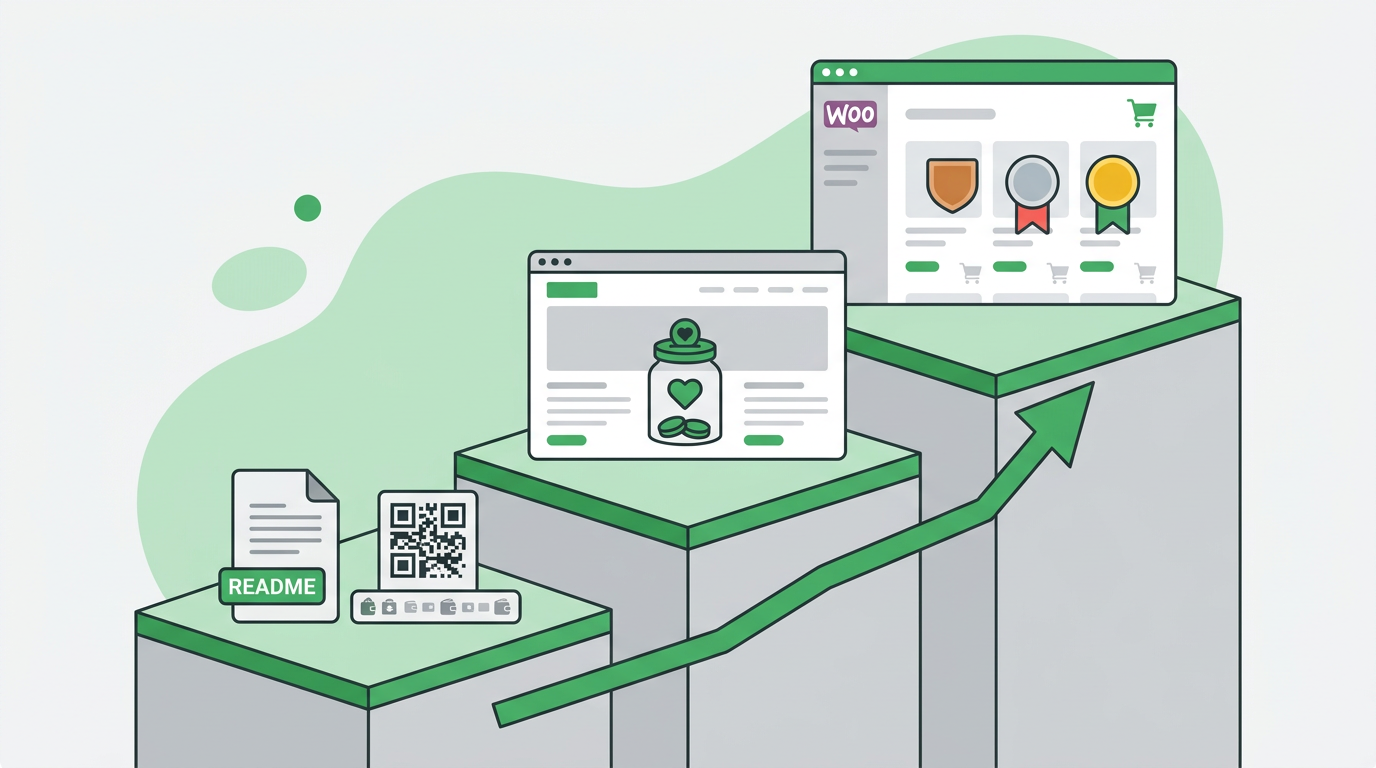
Wallet Address in Your README
The simplest approach is adding a wallet address or ENS name to your project README. Create a dedicated section with addresses for the chains you want to support. At minimum, include an Ethereum/ERC-20 address (for USDT, USDC, ETH) and a Tron/TRC-20 address (for low-fee USDT transfers popular in Asia). Display the addresses as code blocks so sponsors can copy them without formatting issues.
This approach costs nothing to set up, but it has limitations. There is no tracking of who sponsored what amount, no way to offer sponsor tiers or perks, and no automated thank-you flow. It works best as a supplement to a more structured system.
Crypto Tip Jar on Your Project Website
If your project has a documentation site or landing page built on WordPress, you can embed a crypto payment button that handles the checkout flow for you. Visitors click the button, select their preferred token and chain, and send payment directly to your wallet. You can read a full walkthrough in our crypto tip jar setup guide, which covers both WordPress and Shopify implementations.
The advantage over a raw wallet address is user experience. A payment button handles QR code generation, chain selection, and transaction confirmation in a single interface. Sponsors who are not deeply familiar with crypto can complete a contribution without manually copying addresses or choosing the right network. For WordPress-based project sites, the WooCommerce crypto plugin integrates directly into your existing setup.
Dedicated Sponsor Page with Tiers
For projects with enough traction to justify sponsor tiers — say, logo placement in the README for $100/month or priority issue support for $500/month — set up a simple WooCommerce store on your project site. Create products for each tier, enable crypto checkout, and let sponsors pay in their preferred token. This gives you the same tier structure that GitHub Sponsors and Open Collective offer, minus the 5-12% platform cut.
With a non-custodial payment gateway, funds settle directly to your wallet on every transaction. There is no withdrawal process, no payout schedule, and no minimum balance requirement. You receive USDT, USDC, DAI, BTC, ETH, or whichever token the sponsor chooses, and you decide when and how to convert it.
Bounty Platforms: Pay-Per-Contribution Funding
Bounties offer a different model: instead of sponsoring a maintainer, backers fund specific issues or features. Several crypto-native platforms have matured enough to handle real workloads.
Gitcoin Bounties remains the largest crypto bounty platform, having distributed over $60 million in grants and bounties since 2017. Backers attach a bounty (typically in ETH, USDC, or DAI) to a GitHub issue. Contributors claim the issue, submit a pull request, and receive payment on merge. Gitcoin uses smart contracts to escrow funds, so neither party bears counterparty risk.
Bount.ing (formerly Bountysource’s spiritual successor) and Algora focus specifically on open source bounties with crypto payouts. Algora integrates directly with GitHub, automatically posting bounty amounts on issues and releasing payment when PRs are merged. Their fee is 10% of the bounty amount — lower than traditional freelance platforms but still a meaningful cut on smaller tasks.
Self-hosted bounties offer the most flexibility. Post a list of funded issues on your project site, specify the payout amount and token for each, and handle payment directly when work is completed. This approach requires more manual coordination but eliminates all platform fees. If you already accept crypto for sponsorships, adding bounties to the same workflow is straightforward. For details on invoicing and payment tracking as an independent developer, see our freelancer crypto payment guide.
Crypto Grants for Open Source Infrastructure
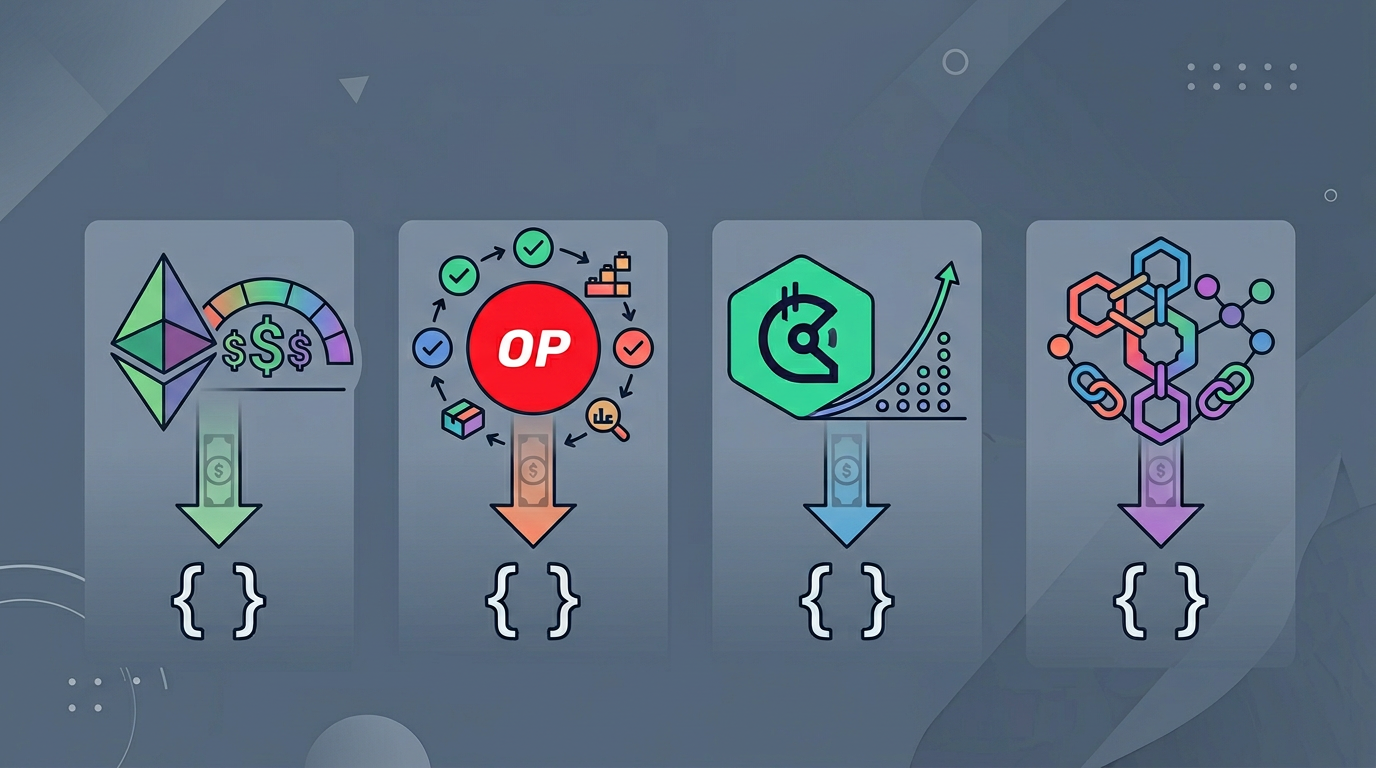
Grant programs have become the largest single source of crypto-denominated open source funding. If your project touches blockchain infrastructure, developer tooling, or public goods, multiple programs are actively distributing capital.
Ethereum Foundation grants range from $10,000 to $500,000 for projects that improve the Ethereum ecosystem. Recent rounds have funded everything from formal verification tools to accessibility improvements in wallet software. Applications are reviewed quarterly, and funds are disbursed in ETH or DAI.
Optimism’s RetroPGF (Retroactive Public Goods Funding) has distributed over $200 million across six rounds. Unlike traditional grants, RetroPGF rewards projects after they have demonstrated impact, which means you do not need to pitch a roadmap — you need to show results. Payouts are in OP tokens, which are liquid on major exchanges.
Gitcoin Grants uses quadratic funding, where small individual contributions are amplified by a matching pool. In Round 20 (Q1 2026), the matching pool exceeded $3 million. A project receiving 500 small donations of $5 each can receive more matching funds than a project receiving five donations of $500, which makes this model ideal for widely used developer tools with large user bases.
Polygon, Arbitrum, and Solana each run ecosystem grant programs ranging from $50,000 to $1 million per project. Even if your tool is not blockchain-specific, if it serves developers who build on these chains, you may qualify. The key is framing your project’s value in terms the ecosystem cares about: developer experience, security, and adoption.
Tax and Compliance Considerations
Crypto sponsorship income is taxable in most jurisdictions, and treating it otherwise creates unnecessary risk. In the US, crypto received as payment for services (including bounty work) is ordinary income, valued at fair market value on the date of receipt. Sponsorship income that resembles a gift may have different treatment, but the IRS has not issued clear guidance on open source sponsorships specifically.
Keep records of every transaction: date, token, amount, USD value at receipt, sender (if known), and purpose. On-chain records provide most of this automatically, which is one advantage crypto has over PayPal or bank transfers where you might receive a lump sum with no context. Many developers use tools like Koinly or CoinTracker to generate tax reports from wallet addresses.
If you receive stablecoins (USDT, USDC, DAI), the tax calculation is simpler because the value is pegged at $1. You avoid the capital gains complexity that comes with volatile assets like ETH or BTC, at least until you convert to fiat. For maintainers who want to minimize accounting overhead, accepting sponsorships exclusively in stablecoins is a practical default.
Choosing the Right Infrastructure
Your payment setup should match your project’s scale and your tolerance for operational complexity. Here is a practical decision framework:
Solo maintainer, under $500/month in sponsorships: Add wallet addresses to your README and project site. Accept USDC on one or two chains (Ethereum mainnet for large contributions, Polygon or Arbitrum for small ones). This costs nothing and takes ten minutes to set up.
Growing project, $500-$5,000/month: Set up a crypto payment button on your project’s WordPress site. Use a non-custodial gateway so funds go directly to your wallet without a third-party holding balance. Offer sponsor tiers through WooCommerce if you want to provide perks like logo placement or priority support. At this level, the 0.8% processing fee on a non-custodial gateway saves you meaningful money compared to Patreon’s 5-12% or Open Collective’s 8-10%.
Infrastructure project, $5,000+/month: Combine direct sponsorships with grant applications and bounty programs. Run a WooCommerce-based sponsor store, apply to ecosystem grants quarterly, and use bounties to fund specific feature work from external contributors. Diversifying funding sources reduces your dependence on any single platform or sponsor.
Why Non-Custodial Matters for Developers
When you accept crypto through a custodial service, you are recreating the same problem you left traditional platforms to escape. A custodial provider holds your funds, controls withdrawal timing, and can freeze your account if their compliance team flags something. For developers who value sovereignty — and most open source developers do — non-custodial payment processing is the only approach that aligns with the ethos of the work.
With a non-custodial setup, every payment settles directly to a wallet address you control. You hold the private keys. There is no intermediary balance, no withdrawal request, no payout delay. The moment a sponsor’s transaction confirms on-chain, the funds are yours. This is how crypto payments were designed to work, and it is the standard your project’s payment infrastructure should meet.
Aurpay operates on this principle. As a non-custodial crypto payment gateway, it routes payments straight to your wallet across 10+ chains including Ethereum, Tron, BSC, Polygon, and Arbitrum. It supports USDT, USDC, DAI, BTC, ETH, BNB, MATIC, and more. The processing fee is 0.8% — a fraction of what Patreon, Open Collective, or PayPal charges. There is no KYC process, so you can start accepting sponsorships in minutes regardless of where you live. And for WordPress-based project sites, the WooCommerce plugin drops into your existing setup without requiring a separate payment stack.
Open source funding does not need another platform that takes a double-digit cut and restricts access by geography. It needs a payment rail that matches the global, permissionless nature of the software itself. Start accepting crypto sponsorships with Aurpay — no KYC, no middleman, funds go straight to your wallet.