
Cross-Border E-Commerce with Stablecoin Payments: A Merchant Guide (2026)
 Ricky
Ricky

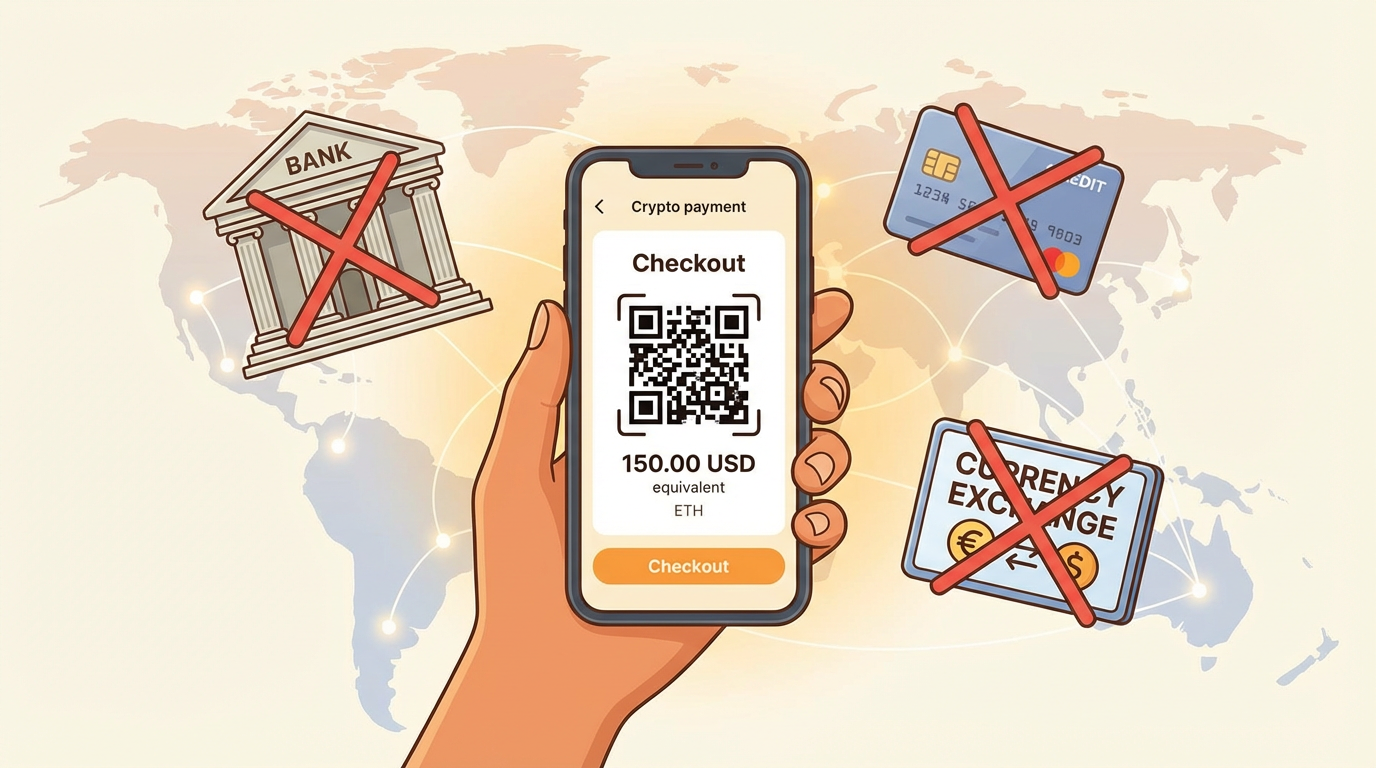
Stablecoin payments let you accept orders from customers in any country at a flat 0.8% processing fee — no foreign transaction surcharges, no currency conversion spreads, and no 3 to 5 day international settlement delays. For e-commerce merchants selling across borders, USDT and USDC on low-fee networks like TRC-20 and Polygon replace the most expensive parts of the traditional payment stack.
Cross-border e-commerce is projected to exceed $7.9 trillion by 2027, yet the payment infrastructure supporting it remains stuck in the 1970s. International credit card transactions carry 1% to 1.5% foreign transaction fees on top of the standard 2.9% processing rate. Wire transfers cost $25 to $50 per transaction and take days to clear. PayPal charges 4.4% plus a fixed fee for cross-border transactions. These costs erode margins on every international order — and for merchants in emerging markets, they can make e-commerce unviable entirely. Stablecoins offer a fundamentally different model.
The Real Cost of Cross-Border Payments
Credit Card Cross-Border Fees
When a customer in Germany buys from a U.S. Shopify store with a credit card, the payment passes through at least four intermediaries: the customer’s issuing bank, the card network (Visa/Mastercard), the acquiring bank, and the payment processor (Stripe, Shopify Payments). Each takes a cut. The merchant pays 2.9% plus $0.30 in base processing, plus a 1% to 1.5% cross-border assessment fee from the card network. The customer may also pay a 1% to 3% foreign transaction fee charged by their bank.
For a $200 order, the merchant loses roughly $8.60 to $10.30 in fees. The customer may lose an additional $2 to $6 on their end. That is up to $16 in friction on a single transaction — before accounting for currency conversion spreads that are baked into the exchange rate but never shown as a line item.
Wire Transfer Limitations
Some B2B and high-value B2C merchants rely on wire transfers for international orders. A typical international wire costs $25 to $50 per transaction, takes 2 to 5 business days through the SWIFT network, and involves correspondent banking fees that can add another $15 to $30 if the transfer passes through intermediary banks. For orders under $500, wire transfer fees make the economics unworkable.
PayPal and Alternative Processors
PayPal charges 4.4% plus a fixed fee for international payments received through its platform. The exchange rate used for currency conversion includes a hidden spread of 2.5% to 4% above the mid-market rate. For a merchant processing $10,000 monthly in international orders through PayPal, the effective cost exceeds $600 per month — and that is before chargebacks, which PayPal handles with a $20 dispute fee.
The Emerging Market Problem
Merchants selling from or to customers in countries with restricted banking access face an even steeper challenge. Customers in Nigeria, Argentina, Turkey, or Pakistan often cannot use international credit cards due to currency controls, low card issuance rates, or bank-imposed spending limits on foreign transactions. These are large consumer markets being excluded from global e-commerce by payment infrastructure limitations, not by lack of demand.
How Stablecoins Fix Cross-Border Payments
One Fee, Anywhere in the World
A stablecoin payment through a non-custodial gateway like Aurpay costs 0.8% regardless of where the customer is located. A buyer in Tokyo, Nairobi, or Sao Paulo pays the same processing fee as one in New York. There are no cross-border assessments, no intermediary bank charges, and no foreign transaction fees. The blockchain network fee (paid by the sender) ranges from less than $0.01 on Polygon to $0.50 on TRC-20 — negligible compared to the $8 to $16 that credit card cross-border transactions cost.
For that same $200 order, the merchant pays $1.60 in gateway fees. The customer pays a few cents in network fees. Total friction: under $2, compared to up to $16 through traditional rails. Over a year of international sales, this difference compounds into thousands of dollars of recovered margin.
No Currency Conversion Required
USDT and USDC are dollar-pegged stablecoins. A customer in any country sends dollar-denominated value without either party needing to convert between local currencies. The merchant receives USDC or USDT worth exactly the order total in USD. There is no exchange rate risk, no conversion spread, and no settlement currency mismatch.
For merchants who price in USD — which includes most international Shopify and WooCommerce stores — stablecoins eliminate the entire currency conversion layer. Your customer sends $200 in USDC, and you receive $200 in USDC. The simplicity of this model is its greatest advantage for cross-border commerce.
Instant Settlement
Stablecoin payments settle on the blockchain in seconds to minutes, depending on the network. TRC-20 transactions confirm in about 3 seconds. Polygon settles in 2 seconds. Even Ethereum mainnet, the slowest option, confirms within 15 minutes. Compare this to the 2 to 5 business days for credit card international settlements or the 3 to 7 days for wire transfers.
Fast settlement means better cash flow for merchants. You can see the funds in your wallet within minutes of the customer completing checkout — no waiting for batch processing, no settlement holds, and no rolling reserves that payment processors impose on cross-border merchants with higher-risk profiles.
Access to Underbanked Markets
Stablecoins reach customers that traditional payment methods cannot. A buyer in Lagos can purchase USDT through a local P2P exchange using their local bank or mobile money, then send it to your store’s checkout in seconds. A customer in Buenos Aires can convert pesos to USDC through any of dozens of local crypto platforms and pay your store directly. These transactions bypass the international banking system entirely.
For merchants targeting emerging markets — digital products, online education, software licenses, fashion — stablecoin checkout opens revenue streams that credit card and PayPal infrastructure simply cannot reach. The World Bank estimates that 1.4 billion adults remain unbanked globally, but smartphone penetration in these markets exceeds 70%. Stablecoins bridge this gap.
Choosing the Right Network for International Customers
Your customers’ network preference depends heavily on their region and wallet ecosystem. Configuring the right networks on your store directly impacts conversion rates.
TRC-20 (Tron) — The Global Default
Tron processes more stablecoin transfer volume than any other blockchain. In markets across Asia, the Middle East, Africa, and Latin America, TRC-20 USDT is the de facto digital dollar. If your store serves a global audience, TRC-20 is the single most important network to enable. Transaction fees stay between $0.10 and $0.50, making it viable for orders of any size. See our TRC-20 low-fee processing guide for network details.
Polygon — Low Cost, Ethereum Compatible
Polygon offers fees below $0.01 and is natively supported by MetaMask, Coinbase Wallet, and most Ethereum-ecosystem wallets. It is the preferred low-fee network for customers in North America and Europe who already operate within the Ethereum ecosystem. Circle issues USDC natively on Polygon, so it carries full 1:1 backing.
ERC-20 (Ethereum Mainnet) — Universal Compatibility
ERC-20 is the most widely supported network across all wallets and exchanges. For high-value cross-border transactions ($500+), the $1 to $5 gas fee is a rounding error compared to the cross-border card fees you are eliminating. Enable ERC-20 as a baseline alongside lower-fee alternatives.
BSC (BEP-20) — Binance Ecosystem
BSC has strong adoption in Southeast Asia and other markets where Binance is the dominant exchange. Fees are below $0.10, and many customers in these regions hold stablecoins on BSC by default. Enable BEP-20 if your analytics show significant traffic from Binance-heavy markets.
Recommended Configuration
For maximum cross-border coverage, enable USDT and USDC on all available networks. The customer selects their preferred network at checkout — you do not need to decide for them. At minimum, enable TRC-20 (global reach) and one EVM low-fee network (Polygon or BSC). Skipping TRC-20 means excluding the largest stablecoin-using population in the world.
Setting Up Cross-Border Stablecoin Checkout
On Shopify
Install the Aurpay Shopify app from the Shopify App Store. In the Aurpay dashboard, enter your wallet addresses (one for EVM networks, one for Tron if enabling TRC-20). Enable USDT and USDC on your target networks. The checkout automatically detects the customer’s selection and generates the correct wallet address and amount. No geolocation or currency detection logic is needed — the customer chooses their preferred stablecoin and network.
On WooCommerce
Install the Aurpay WooCommerce plugin through your WordPress admin panel. Configuration mirrors the Shopify setup — wallet addresses, currency selection, and network toggles. WooCommerce stores have additional flexibility to customize the checkout page through standard WooCommerce hooks if you want to add guidance for international customers on which network to select.
Pricing in USD
Keep your store priced in USD (or your base currency). The payment gateway converts the order total to the exact stablecoin amount at checkout. Since USDT and USDC are pegged 1:1 to USD, the conversion is straightforward — a $150 order shows as 150 USDC or 150 USDT. For stores priced in EUR, GBP, or other currencies, the gateway converts at the current market rate.
Cross-Border Compliance Considerations
Accepting stablecoin payments does not exempt you from trade compliance, export controls, or tax obligations in your jurisdiction. Key considerations for international merchants:
Sanctions screening. You are responsible for ensuring you do not process orders from sanctioned countries or individuals. Blockchain transactions are pseudonymous — the customer’s wallet address does not reveal their identity. Apply the same screening you would for any international order: verify shipping addresses, use order review workflows for high-risk jurisdictions, and maintain transaction records.
Tax reporting. Revenue from stablecoin payments is taxable income in most jurisdictions. Because USDT and USDC are dollar-pegged, the tax treatment is simpler than for volatile cryptocurrencies — the value at receipt equals the value at conversion. Record each payment with its date and USD value for your tax filings.
Consumer protection. Your refund and return policies apply regardless of payment method. If a customer requests a refund, send stablecoins back to their wallet address. Since blockchain transactions are irreversible, refunds must be initiated by you — there is no chargeback mechanism. Clearly communicate your refund policy at checkout.
The GENIUS Act compliance framework is worth reviewing if you are a U.S.-based merchant, as it may introduce new reporting requirements for businesses accepting stablecoin payments above certain thresholds.
Real-World Cost Comparison
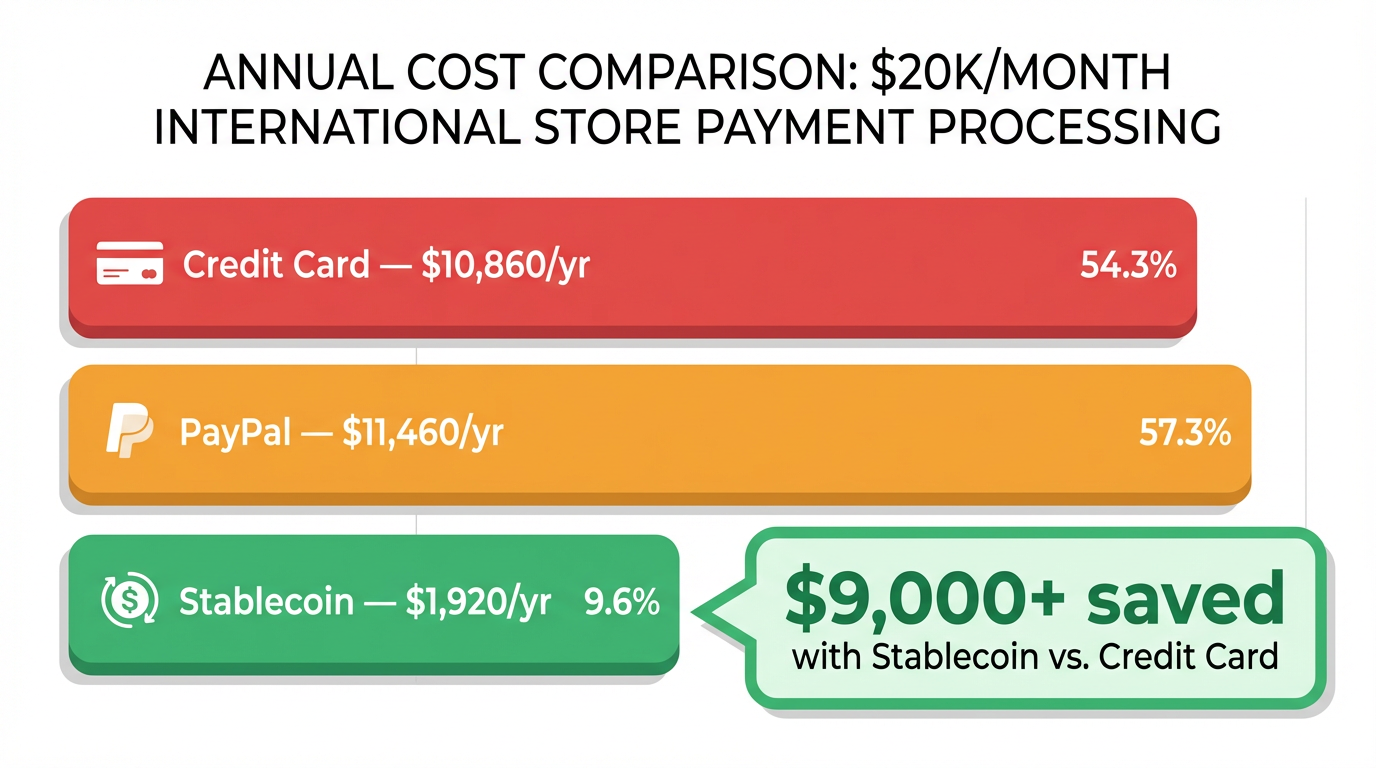
Consider a WooCommerce store doing $20,000 per month in international sales, with an average order value of $80.
| Payment Method | Fee per $80 Order | Monthly Cost (250 orders) | Annual Cost |
|---|---|---|---|
| Credit card (cross-border) | $3.62 (2.9% + $0.30 + 1.2% cross-border) | $905 | $10,860 |
| PayPal (international) | $3.82 (4.4% + $0.30 + FX spread) | $955 | $11,460 |
| Stablecoin (Aurpay) | $0.64 (0.8%) | $160 | $1,920 |
Annual savings: $8,940 to $9,540 compared to traditional cross-border payment methods. Even if only 30% of your international customers pay with stablecoins, you save $2,700 to $2,860 per year on a $20,000 monthly volume.
Driving Stablecoin Adoption Among International Customers
Adding stablecoin checkout is the first step. Getting international customers to use it requires visibility and education.
Display the crypto option prominently. Place it alongside your existing payment methods at checkout, not behind a “more options” toggle. Use clear labeling: “Pay with USDC/USDT (Save on international fees)” communicates the benefit directly.
Offer a discount for crypto payments. A 2% to 3% discount for stablecoin payments still leaves you ahead of credit card processing costs while giving price-sensitive international buyers a clear incentive to switch. This is especially effective for repeat customers who can be nudged through email marketing.
Add a checkout guide. Many international customers hold stablecoins but have never used them for e-commerce purchases. A short “How to pay with USDC” help section — explaining wallet options and network selection — reduces friction and abandoned checkouts.
Highlight in market-specific pages. If you have dedicated landing pages or marketing for specific international markets, mention stablecoin checkout as a feature. “Ship worldwide, pay with crypto — no cross-border fees” resonates in markets where card fees and currency controls are painful daily realities.
Start Selling Globally with Stablecoin Payments
Cross-border e-commerce should not cost 4% to 7% in payment fees. Stablecoins collapse the international payment stack into a single, low-cost layer — dollar-denominated, instant settlement, no intermediary banks, no currency conversion, and accessible to customers that traditional payment rails exclude. For merchants selling internationally on Shopify or WooCommerce, adding stablecoin checkout is the highest-ROI change you can make to your payment infrastructure.
Aurpay’s non-custodial gateway supports USDT and USDC across Ethereum, Tron, Polygon, Arbitrum, and BSC — covering every major stablecoin network your international customers use. Processing fee is 0.8% flat, with no cross-border surcharges and no settlement delays. Set up stablecoin payments on your Shopify or WooCommerce store and start reaching a global customer base today.